
In the latest developments on the global stage today, world power dynamics continue to undergo significant shifts. International focus is currently divided between the Middle East, where a diplomatic breakthrough with Iran appears to be on the horizon, and the Asia-Pacific, where the United States is projecting a notable change in tone regarding its relationship with China. Here is an in-depth look at today’s most critical geopolitical stories.
Trump Signals Potential Iran Deal Amid Strait of Hormuz Tensions
President Donald Trump has provided strong indications that a diplomatic breakthrough with Iran may be imminent, even as military tensions in the Middle East’s most strategic waterways remain at a boiling point.
In a statement posted to social media early today, President Trump announced that a “final decision” regarding a comprehensive deal with Tehran is “imminent.” This declaration comes amidst a prolonged standoff and escalating military posturing in the region.
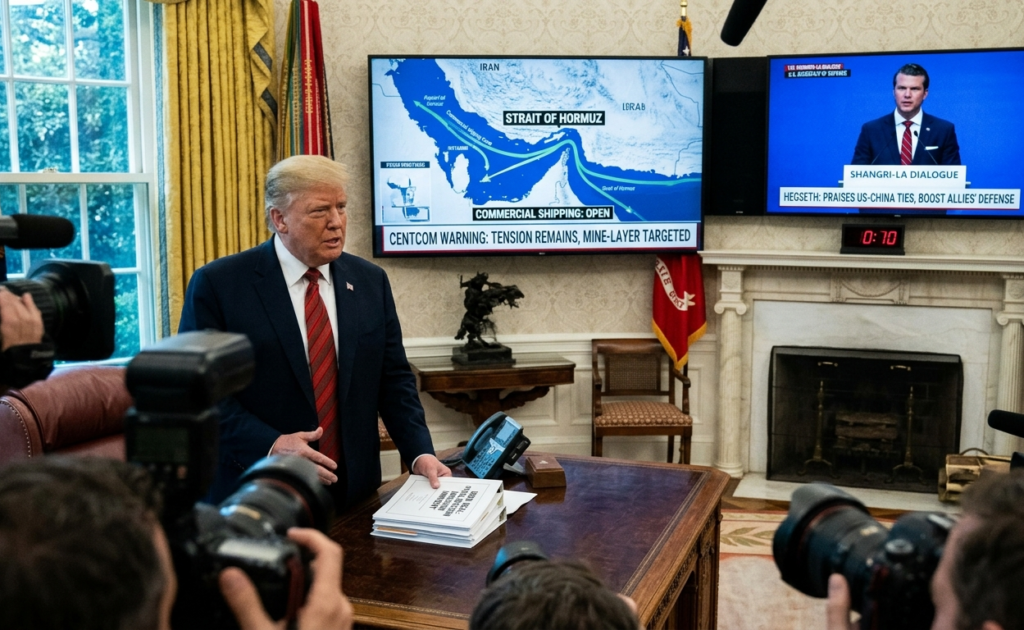
The crux of the United States’ demands, as emphasized by Trump, centers on the restoration of maritime traffic in the Strait of Hormuz—one of the world’s most vital maritime chokepoints for global oil transportation. “The Strait of Hormuz must be reopened to commercial shipping,” the President asserted in his post. In exchange for guarantees of freedom of navigation, Trump promised that the United States is prepared to lift its current maritime blockade.
However, the optimism for a diplomatic resolution stands in stark contrast to the highly volatile operational reality on the ground. Shortly after the President’s statement, U.S. Central Command (CENTCOM), which oversees military operations in the region, issued a stern warning that underscores the fragility of the situation.
CENTCOM declared that its naval forces will target any vessels detected engaging in mine-laying activities “in self-defense.” This warning is part of an ongoing maritime security operation designed to protect international shipping and highlights the very real danger that a tactical miscalculation could ignite an open conflict before any diplomatic ink can dry.
Hegseth at Shangri-La: Praising US-China Ties While Urging Allied Defense Spending
Halfway across the globe, at the Shangri-La Dialogue in Singapore—Asia’s premier annual defense summit—U.S. Secretary of Defense Pete Hegseth delivered an address that showcased a shifting nuance in Indo-Pacific security relations.
Speaking before an audience of global defense ministers and top military brass, Hegseth offered a surprisingly optimistic assessment of the bilateral relationship between Washington and Beijing. He remarked that diplomatic and military relations between the two superpowers are “better than they’ve been in many years.” This statement marks a notable departure from the highly confrontational rhetoric that has frequently dominated the forum in recent years.
Despite the positive tone regarding high-level communication, Hegseth swiftly balanced his remarks with a pragmatic assessment of regional military realities. He pointed directly to China’s “historic military build-up” and the rapid modernization of the People’s Liberation Army (PLA).
Hegseth utilized this fact as a central argument to pressure United States allies and partners in the Indo-Pacific to take greater responsibility for their own security. Framing the Chinese military expansion as a critical catalyst, he urged U.S. allies to significantly boost their own defense budgets, signaling Washington’s expectation of greater burden-sharing in the regional collective security posture.
Perhaps the most striking detail of Hegseth’s speech, however, was what he omitted. In sharp contrast to his appearance at the same summit last year—where he explicitly warned of a potential Chinese invasion of Taiwan and firmly reiterated U.S. commitments—the Defense Secretary made absolutely no mention of the self-governing island this year. This glaring omission has sparked widespread speculation among defense analysts regarding whether this represents a calculated effort to de-escalate tensions with Beijing, or a broader strategic shift in Washington’s Pacific priorities.
Stay tuned to The World in Brief for ongoing coverage and expert analysis on how these unfolding events will shape the global geopolitical landscape.