
The Market Is Wrong About the Fed: PGIM’s Three-Hike Forecast and the Dangerous Complacency of Consensus

While Wall Street bets on an indefinite pause, one of the world’s largest fixed-income managers is forecasting three rate hikes in 2026 — a call that, if right, would trigger one of the most severe repricing events in recent bond market history. With Kevin Warsh’s inaugural FOMC meeting opening today, the moment of reckoning may be closer than anyone dares admit.
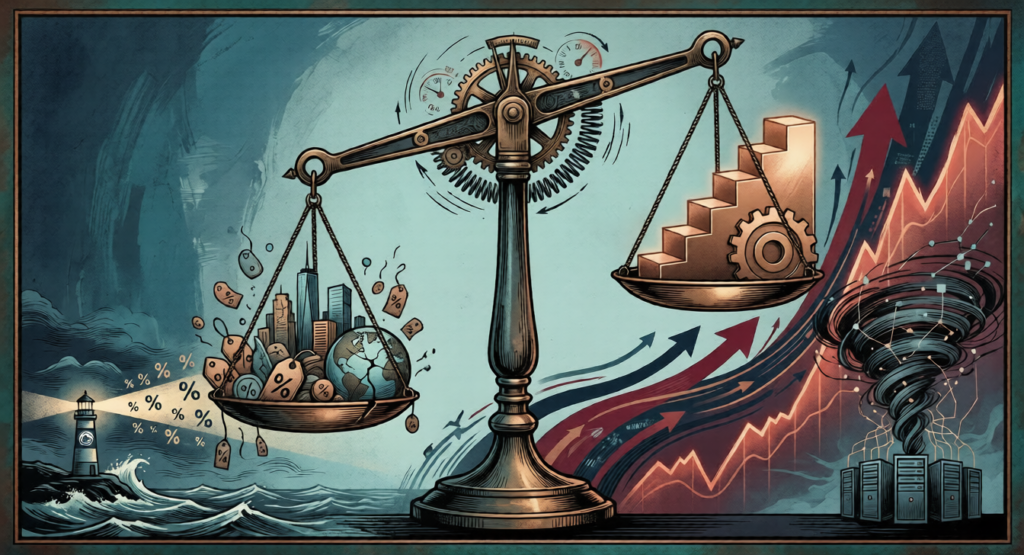
In the world of institutional investment management, where the management of trillions of dollars in assets demands an unusual combination of epistemic humility and decisive conviction, PGIM Fixed Income has done something remarkable: it has staked out a position on the Federal Reserve’s 2026 interest rate path that sits so far outside the mainstream consensus that it amounts not merely to a contrarian call, but to an indictment of the entire market’s analytical framework. On a day when the Federal Open Market Committee convenes in Washington, D.C., for what is simultaneously the most anticipated and most dreaded meeting of Kevin Warsh’s brief tenure as the Fed’s 17th chairman, PGIM is telling anyone willing to listen that the market has fundamentally misread where this economy is going — and that the bill for that misreading is going to come due very soon.
The core of PGIM’s argument is both simple and alarming in its implications. The asset management giant, a subsidiary of Prudential Financial with more than $1.3 trillion under management and a fixed-income operation that ranks among the largest on the planet, is forecasting that the Federal Reserve will raise interest rates by 25 basis points three separate times in 2026. Three hikes. Each one a quarter of a percentage point. Together, they would push the federal funds rate from its current target range of 3.50%–3.75% to a range of 4.25%–4.50% by year-end — a level not seen since the peak of the 2022–2023 tightening cycle that inflicted significant pain on both bond markets and rate-sensitive sectors of the economy.
To understand why this call is so striking, one need only look at what the rest of the market is pricing. According to data from the CME FedWatch Tool as of June 13, 2026, a staggering 97.1% of traders in the fed funds futures market expect the FOMC to hold rates exactly where they are at this week’s June 16–17 meeting. Not one cut. Not one hike. A complete hold. That near-unanimity of short-term expectation is itself not particularly controversial — the hold is genuinely widely expected, and PGIM does not disagree with it. The divergence begins when you look further out. The market currently assigns approximately a 41% probability that rates will be unchanged all the way through year-end, a 42% probability of just a single quarter-point hike, and a mere 14% probability of a cumulative 50 basis point increase by December. PGIM, in contrast, is projecting 75 basis points of tightening — three hikes — a forecast the firm itself acknowledges lies, in its own words, “well outside the consensus.”
“Economic resilience in the U.S. economy, inflation risks, and renewed strength in the labor market will push the central bank to make those moves. America is now facing high inflation with upside risks.”— PGIM Fixed Income, June 2026 Outlook
Essential Data Points — June 16, 2026
- Current Fed Rate3.50%–3.75% (held since April 29, 2026 FOMC meeting)
- PGIM ForecastThree 25 bps hikes in 2026 → target range of 4.25%–4.50% by year-end
- Market Consensus41% chance of no change; 42% chance of one hike; 14% chance of +50 bps (CME FedWatch)
- Core PCE (April)3.3% year-over-year — well above the Fed’s 2% target; described by PGIM as “uncomfortably high”
- Headline PCE (April)3.8% year-over-year — highest reading since May 2023
- Unemployment Rate~4.2%–4.3% (stable; labor market not materially deteriorating)
- June Jobs Report172,000 jobs added — significantly above consensus expectations
- Q1 GDP (Revised)1.6% annualized growth (revised down from initial 2.0% estimate)
- Fed ChairKevin Warsh (17th Chair, sworn in May 15, 2026); June 16–17 is his first FOMC meeting
- PGIM Rate OutlookThree hikes in 2026 → three cuts in 2027 → one final cut in 2028
The Anatomy of PGIM’s Case: Why Three Hikes?
PGIM’s argument for three rate hikes rests on a convergence of three structural forces that, in its assessment, the market has systematically underweighted — either through wishful thinking, political noise, or a misapplication of historical analogies to a genuinely novel macroeconomic environment.
First Force: Inflation That Simply Won’t Cooperate
The most direct pillar of PGIM’s hawkish case is the state of inflation, and the numbers here are, by any fair reading, uncomfortable. The Personal Consumption Expenditures price index — the Federal Reserve’s preferred inflation gauge, the one that shapes its decisions and informs its forecasts — rose 3.8% on a year-over-year basis in April 2026, according to data cited by CBS News. That is the highest reading for the PCE since May 2023 — nearly three years ago — and it puts headline inflation at nearly twice the Fed’s stated 2% target. Core PCE, which strips out the volatility of food and energy prices in order to give policymakers a cleaner read on where prices are genuinely heading, came in at 3.3% annually in April, right in line with economist forecasts. The monthly gain was 0.2%, a touch below the 0.3% estimate — but that small relief was more than offset by the annual picture.
PGIM describes core PCE at 3.3% as “uncomfortably high,” and it is difficult to argue with the characterization. The housing component of PCE saw its biggest monthly gain since January 2025, rising 0.5%. Energy prices surged 5.5% in the month alone, driven by the ongoing disruption to global petroleum flows caused by the Iran conflict and its effects on the Strait of Hormuz — a chokepoint through which approximately 20 million barrels of oil pass every day, representing roughly 20% of global demand. The personal savings rate hit a three-year low in the same period, with consumer spending outpacing flat income growth — a dynamic that, while it supports short-term GDP readings, points to a household sector drawing down its cushion and becoming more financially vulnerable to any further price pressure.
The inflation trajectory that PGIM is tracking is not one of gradual improvement creeping toward the Fed’s target. It is one of renewed acceleration, driven by a combination of energy price shocks, tariff pass-through costs that are proving stickier than many models anticipated, and a labor market that, as we will discuss, has shown more resilience than the softening narrative would suggest. At 3.3% core PCE with the Fed’s benchmark rate at 3.50%–3.75%, real interest rates are barely positive. As Money Morning’s analysis noted bluntly, “that is not a restrictive posture.” A policy rate that is only marginally above the core inflation rate has, historically, been insufficient to bring inflation down in a sustained and durable way.
Second Force: A Labor Market That Refuses to Break
The second element of PGIM’s thesis is the American labor market. For much of 2025 and early 2026, the narrative around employment was one of gradual softening — rising unemployment claims, cooling wage growth, a slowing in job creation that would, in theory, reduce income pressure on inflation and give the Fed the cover it needed to cut rates. That narrative has not aged well.
The most recent jobs report showed the U.S. economy adding 172,000 positions — a number described by Kiplinger as “far above expectations” and one that caused Goldman Sachs to drop its forecast for a December 2026 rate cut entirely, pushing its expected easing timeline all the way to 2027. The unemployment rate sits at approximately 4.2%–4.3%, a level that, while modestly above historic lows, does not constitute the kind of labor market deterioration that would compel a central bank to loosen policy in an environment where inflation is accelerating. Private sector job creation, while close to flat in some measures, has not produced the significant employment losses that typically precede or accompany Fed rate cuts.
PGIM’s framing — that “renewed strength in the labor market” is a key driver of its hawkish call — reflects this reality. A tight labor market tends to sustain consumer spending, which in turn sustains price pressure, which in turn removes the justification for rate cuts. It is a self-reinforcing feedback loop that the market’s rate-cut optimism has consistently failed to account for. The April FOMC meeting minutes — Jerome Powell’s last as chairman, the session that produced the highest number of dissenting votes since 1992 — indicated that a broad swath of FOMC officials signaled they could be compelled to tighten policy if inflation failed to retreat, and expressed a desire to remove the statement language favoring additional easing. That was the committee under Powell’s leadership. Under Warsh, the calculus may shift further toward hawkishness.
Third Force: Economic Resilience Defying the Slowdown Script
The third element in PGIM’s framework is what it calls the “economic resilience” of the U.S. economy — a resilience that is itself paradoxical in some respects, but which PGIM reads as a constraint on the Fed’s ability to pivot toward easing. Q1 GDP was revised down to 1.6% annualized growth from an initial 2.0% estimate, driven primarily by softer consumer spending and business investment than first reported. Durable goods orders surged 7.9% in April, but the vast majority of that increase was attributable to aircraft orders; strip out transportation, and the underlying gain was a more modest 1.1%. These data points suggest an economy that is decelerating at the margin, but not collapsing — running, as one analysis characterized it, on a “shrinking savings cushion” while inflation stays stuck above target.
This is precisely the stagflationary configuration that is most difficult for a central bank to navigate: growth that is too strong to justify dramatic loosening, but not generating the wage and productivity gains that would help absorb higher prices. It is also the configuration that most severely limits the Fed’s room for maneuver. In a world of slowing growth and falling inflation, the choice between cutting and holding is relatively straightforward. In a world of slowing growth and rising inflation, every policy option carries significant costs.
Market-Implied Rate Probabilities at Year-End 2026 — CME FedWatch (as of June 13, 2026)
Rates Unchanged (3.50%–3.75%)41%
One 25 bps Hike (3.75%–4.00%)42%
Two 25 bps Hikes (+50 bps total)14%
Three Hikes (+75 bps total) — PGIM’s Call<3%
Source: CME FedWatch Tool. Market pricing based on 30-Day Fed Funds futures contracts. PGIM’s three-hike forecast falls dramatically outside what markets currently price.
The Warsh Factor: A Chairman Caught Between Data and Politics
No analysis of the Federal Reserve’s 2026 rate path can ignore the most consequential institutional change the central bank has undergone in years: the transition from Jerome Powell to Kevin Warsh as Fed chairman. Warsh, a former Fed governor who served from 2006 to 2011 and built a reputation as an inflation hawk during that tenure, was sworn in as the 17th Fed chair on May 15, 2026. Today — June 16 — is the first day of his first FOMC meeting as chairman. Wednesday will produce his first rate decision, and, if Warsh follows through on reported skepticism about the utility of Fed press conferences and quarterly forecasting, possibly his last post-meeting press conference as well.
The political context surrounding Warsh’s appointment is one of the most unusual in the history of Fed leadership transitions. President Trump nominated Warsh in explicit part because he believed the former governor would deliver the rate cuts that Trump had loudly demanded from Powell for years. Trump stated publicly as recently as February 2026 that he would not have chosen Warsh if Warsh had wanted rate hikes. Yet the economic data has moved, aggressively, against that expectation. Inflation has accelerated to a three-year high. The labor market has proven more resilient than anticipated. And on Sunday, June 15 — just one day before Warsh’s first FOMC meeting — Trump appeared on NBC to publicly challenge the market’s rate-hike narrative, stating that increases would be “the wrong course of action” and calling on the Fed to cut rates. He added that he had “great respect” for Warsh but that a country “performing well” should not be penalized with higher rates.
This creates a political dynamic of almost unbearable complexity for Warsh. If the data demands hikes and he delivers them, he risks an open rupture with the president who appointed him and who has made no secret of his views on interest rates. If he defers to political pressure and holds or cuts in the face of above-target inflation, he risks undermining the Fed’s credibility as an inflation fighter — potentially entrenching the very inflationary expectations that make the Fed’s job harder over time. EY-Parthenon chief economist Gregory Daco summarized the bind succinctly: “Warsh faces a challenging backdrop as steady labor market conditions alongside rising inflation risks increase the odds of a rate hike as the next policy move.”
The internal dynamics of the FOMC compound the challenge further. The April 2026 meeting — Powell’s final as chairman — produced three dissenting votes, the most on a Fed policy statement since 1992, from officials who wanted the committee to remove language signaling a preference for lower rates. The minutes from that meeting show a majority of officials indicating that “some policy firming would likely become appropriate if inflation were to continue to run persistently above 2 percent.” That language represents an implicit collective acknowledgment that hikes are back on the table. Warsh inherits a committee that is, by recent historical standards, unusually divided — and a committee majority that appears to be leaning toward tightening if the data does not improve.
“Warsh faces a challenging backdrop as steady labor market conditions alongside rising inflation risks increase the odds of a rate hike as the next policy move.”— Gregory Daco, Chief Economist, EY-Parthenon, June 2026
PGIM 2026 Forecast
+3
Rate hikes of 25 bps each, pushing rates to 4.25%–4.50%
PGIM 2027 Forecast
−3
Rate cuts as inflation retreats following tightening cycle
PGIM 2028 Forecast
−1
One final cut to achieve terminal easing rate
Current Consensus
Hold
41% probability of no change all year; 42% for just one hike
The Ghost of Mistakes Past: What History Says About Underpriced Rate Paths
PGIM’s warning about markets “underpricing” the Fed’s rate path is not merely an abstract forecast — it carries within it an implicit historical warning about what happens when investors systematically misjudge central bank policy trajectories. The consequences of that kind of misjudgment, in fixed income and equities alike, can be severe and swift.
The most recent and vivid illustration is the 2022 tightening cycle, when the Federal Reserve — having spent most of 2021 insisting that inflation was “transitory” — was forced to pivot with unusual aggression, raising rates by 525 basis points between March 2022 and July 2023. Markets that had priced in a gradual, modest tightening cycle were blindsided. The Bloomberg U.S. Aggregate Bond Index, a benchmark for the investment-grade bond market, suffered its worst annual loss in modern history. Equity valuations, which had been inflated by the assumption of permanently low discount rates, repriced sharply downward. The lesson, widely absorbed but apparently incompletely retained, was that when a central bank is genuinely committed to fighting inflation, the terminal rate can end up substantially higher than what markets priced at the outset of a hiking cycle.
PGIM’s contention is that something structurally similar is playing out in 2026, albeit from a different starting point. The market consensus — a hold for now, perhaps one hike by year-end, and then a gradual return to cuts — is implicitly predicated on the assumption that the inflation surge of early 2026 is a transient phenomenon driven primarily by energy price shocks from the Iran conflict, that those shocks will fade as geopolitical conditions stabilize, and that the underlying inflation trend remains benign enough to justify eventual easing. PGIM disputes each link in that analytical chain.
On the energy shock thesis: while it is true that the Iran conflict has been a significant driver of higher gasoline prices and headline PCE, PGIM and other hawkish analysts note that core PCE — which excludes energy — is also running at 3.3%, well above target. This suggests that inflationary pressures are not solely a function of energy costs; they are embedded more broadly in services prices, housing, and wage dynamics. A ceasefire or other resolution in the Middle East might relieve some of the headline pressure, but it would not automatically fix the core inflation problem.
The Timeline of a Policy Reversal: How We Got Here
Late 2025 — The Pivot
Three Cuts, a Soft Landing, and Year-End Optimism
The Federal Reserve cuts rates three times in H2 2025, bringing the benchmark to 3.50%–3.75%. Markets price a continued easing path for 2026. The “soft landing” narrative reaches its peak of credibility. Investors at the start of 2026 are forecasting at least two quarter-point cuts by year-end, per CME FedWatch data.
Early 2026 — The Iran Shock
Oil Spikes, Inflation Reignites, Rate-Cut Bets Evaporate
The Iran war disrupts the Strait of Hormuz, spiking global oil prices. The ripple effects push PCE inflation rapidly higher — from 2.8% in February to 3.5% in March and 3.8% in April, the highest since May 2023. Rate-cut expectations evaporate. The FOMC holds rates unchanged at every 2026 meeting.
March 2026 — FOMC Divided
Powell’s Final Months, Warsh’s Looming Appointment
The March FOMC statement holds rates at 3.50%–3.75% “citing uncertainty about the economic outlook.” The near-term rate path implied by futures prices shifts higher. The modal path based on options prices shifts to no change for the year. Hike probability through early 2027 rises to ~30%. Internal divisions intensify.
April 29, 2026 — Powell’s Last Meeting
Most Dissents Since 1992, Minutes Signal Readiness to Hike
Jerome Powell’s final FOMC meeting produces three dissenting votes — the highest since 1992. Minutes show a majority willing to “firm policy” if inflation persists above 2%. Goldman Sachs drops its 2026 rate-cut forecast entirely. April PCE arrives at 3.8% headline / 3.3% core.
May 15, 2026 — Warsh Sworn In
New Chair, Same Inflation Problem, Opposite Political Pressure
Kevin Warsh takes over as the Fed’s 17th chair. He inherits a divided committee, 3.8% headline inflation, a labor market that added 172,000 jobs in the latest report, and a president publicly demanding rate cuts. Options markets already price ~80% probability of at least one hike by year-end despite Warsh’s nominal dovish reputation.
June 16–17, 2026 — The Reckoning
Warsh’s First FOMC Meeting Opens; PGIM’s Forecast Enters the Spotlight
The FOMC convenes for its fourth meeting of 2026 — the first under Warsh. A rate hold is widely expected, with 97.4% of traders pricing no change (CME FedWatch). But PGIM’s three-hike forecast, published ahead of the meeting, forces markets to confront the possibility that the hold is a pause, not a terminal point. The June SEP will provide updated projections. All eyes are on Warsh’s post-meeting press conference — which he may also be considering eliminating.
PGIM’s Endgame: Short-Lived Hikes, Then a Reversal
One of the most important nuances in PGIM’s forecast — and one that distinguishes it from a purely hawkish, inflation-at-all-costs policy prescription — is the firm’s view that the hike cycle it is forecasting will be relatively brief. PGIM does not envision the Fed raising rates to 4.25%–4.50% and keeping them there indefinitely. Instead, the firm’s base case calls for three cuts in 2027, followed by one final cut in 2028, ultimately bringing rates to a lower terminal level once inflation has been durably controlled. The total trajectory, then, is a sharp tightening in the near term followed by a more sustained easing as those tighter financial conditions work their way through the economy and bring price pressures to heel.
This forecast structure mirrors, in broad strokes, the experience of the 2022–2023 tightening cycle, where aggressive Fed action ultimately did succeed in bringing inflation down substantially from its 9.1% peak, though at the cost of significant economic disruption and financial market volatility. PGIM’s implicit contention is that the same pattern will repeat itself: the medicine is unpleasant, the market will resist pricing it in until forced to by the data, and once the central bank acts, the eventual disinflationary outcome will create space for subsequent easing.
The critical question, of course, is whether that model holds in a world where the initial conditions are different from 2022. Inflation is not at 9%; it is at 3.8% headline and 3.3% core. The labor market, while tight, is not at its 2022 peak of 3.5% unemployment. The economy is growing at 1.6%, not at the elevated rates that characterized the post-pandemic reopening. These differences argue, potentially, for a smaller and more targeted hiking cycle than the one PGIM is projecting. But they equally argue against the complacent hold-and-wait posture that most of the market currently embodies.
Market Implications: What Happens If PGIM Is Right?
For investors across asset classes, the question of whether PGIM’s call is correct carries enormous practical consequences. The asset allocation implications of a world in which the Fed hikes three times in 2026 are substantially different from the implications of the consensus hold-or-one-hike scenario.
If PGIM Is Right (Three Hikes)
- Short-duration bonds reprice sharply upward in yield; long-duration bonds face significant mark-to-market losses
- Growth stocks and high-multiple equities compress as discount rates rise; value sectors may outperform
- Mortgage rates climb further above already-elevated levels, deepening the housing affordability crisis
- Dollar likely strengthens as U.S. rates widen relative to G7 peers, putting pressure on emerging market currencies
- Credit spreads widen as higher base rates stress leveraged balance sheets; HY bonds face dual pressure
- Recession risk rises in 2027 as cumulative tightening slows consumer spending and business investment
- Eventual 2027 cuts create a bond rally opportunity for those positioned early in the easing cycle
If Consensus Is Right (Hold / One Hike)
- Bonds broadly stable; limited volatility in short-duration as markets have already priced a pause
- Equities potentially benefit from relief rally if inflation proves transitory and cuts re-enter the picture
- Mortgage rates stay elevated but stable; housing market remains subdued without further deteriorating
- Dollar trajectory less clear; potential for modest weakening if rate differentials narrow versus EU/Japan
- Credit markets broadly stable; HY issuers retain refinancing access at current spread levels
- Soft landing scenario preserved; probability of 2026–2027 recession remains low
- But inflation risk remains embedded: if core PCE does not fall, consensus must eventually reprice
The asymmetry here is significant, and it is one of PGIM’s implicit arguments for why its forecast deserves serious attention even if one assigns it less than a 50% probability. The downside scenario — in which PGIM is right and the market is wrong — involves a disorderly repricing event in the bond market, spread widening in credit, equity de-rating, and a potential hard landing in 2027 as the cumulative effect of tighter monetary conditions slows the economy more than intended. The upside scenario — in which consensus holds and the Fed genuinely does nothing or does very little — is already largely priced in. In investment terms, the expected value of hedging against PGIM’s scenario is substantially higher than the cost of the insurance.
Options markets appear, at the margin, to have begun incorporating this dynamic. As IndexBox reported, options markets assigned roughly 80% probability to at least one quarter-point hike before year-end, even as those same markets priced a 65% probability of a hold at the immediate June meeting. This divergence — a near-certain hold in June, but significant hike risk by December — reflects the market’s gradual, incomplete, and still-resistant accommodation of the PGIM-style scenario.
The Broader Context: Is America Repricing Its Monetary Future?
Stepping back from the specific mechanics of PGIM’s forecast, the episode raises a question of considerable importance for how investors should think about U.S. monetary policy in the era of the second Trump administration. The political economy of interest rate decisions has become unusually fraught in ways that create genuine analytical uncertainty beyond the already-difficult task of forecasting inflation and growth.
President Trump has, since the very beginning of his second term, made aggressive demands for lower interest rates — first from Powell, now from Warsh. He has publicly stated that economic performance justifies lower rates and that higher rates “penalize” a successful economy. He appointed Warsh in part on the expectation that his new chairman would deliver cuts. The Federal Reserve’s institutional independence — its ability to make policy decisions based solely on the dual mandate of price stability and maximum employment, free from political interference — is therefore being tested in real time at precisely the moment when the data is most demanding of hawkish action.
FOMC minutes and public statements from Fed officials make clear that the committee understands this tension. The April dissents, the removal of easing-bias language, the willingness of officials on the record to signal that hikes may be necessary — these are all, in part, institutional assertions of independence from a political environment that is loudly demanding the opposite policy. Whether Warsh can navigate this tension — whether he will prioritize the data or the political relationship that put him in his current chair — is, arguably, the most consequential unknown in American monetary policy in 2026.
PGIM’s forecast implicitly assumes that the data will eventually win. That the combination of a 3.3% core PCE, a strong labor market, and economic resilience will force the Fed’s hand regardless of political pressure, regardless of Warsh’s nominal dovish disposition, regardless of the market consensus — because the alternative, allowing inflation to become entrenched, is a failure of mandate that no credible central bank can afford. If that assumption is correct, the current market pricing is not merely wrong; it is dangerously wrong, and the adjustment will be painful.
A policy rate that is only marginally above the core inflation rate has, historically, been insufficient to bring inflation down in a sustained and durable way. “Less bad than feared” is not the same as good.— Money Morning / Global Markets Journal Analysis, June 16, 2026
What to Watch at the June 17 Press Conference
With the rate decision itself almost certain to be a hold — CME FedWatch assigns a 97.4% probability to no change — the real information content of this FOMC meeting will come from three sources: the updated Summary of Economic Projections (the “dot plot”), the language of the FOMC statement itself, and Kevin Warsh’s post-meeting press conference, which he may be delivering for the first time and possibly the last.
On the dot plot: markets will scrutinize the median 2026 year-end rate projection with unusual intensity. The March dot plot showed the median official still projecting one cut by year-end — a forecast that, given the subsequent data, appears increasingly difficult to sustain. If the June SEP shifts the median projection to no cuts, or, more significantly, to one hike, the market reaction will be swift and significant. Two or more hikes in the median projection would represent a seismic shift that would immediately begin repricing the longer end of the yield curve.
On the statement: the removal or retention of language about the Fed’s willingness to ease will be read as a signal about the committee’s directional bias. Any language acknowledging “upside inflation risks” or “appropriate firming” will be interpreted as the groundwork for future tightening. A more neutral or hold-oriented statement will provide some relief to rate-sensitive markets.
On Warsh’s press conference: this is the unknown variable. Warsh’s public communications philosophy has been unconventional by Fed standards — he has reportedly expressed skepticism about the value of quarterly press conferences and published economic forecasts, viewing them as opportunities for misinterpretation that can inadvertently create market volatility. If he proceeds with a press conference, every word will be dissected for hints about his personal inflation assessment, his relationship with the FOMC majority, and his willingness to act if the data demands it. If he signals openness to the possibility of future hikes, PGIM’s call will look substantially less extreme by Wednesday afternoon.
Conclusion: When the Outlier Becomes the Most Important Voice in the Room
In the epistemology of financial markets, outlier forecasts serve a function that is easy to underestimate when they first appear. They are not merely curiosities or provocation for the sake of contrarianism. At their best, they force the consensus to articulate its assumptions more explicitly, to identify the evidence it is relying on, and to grapple with the scenarios it has been quietly excluding from its base case. PGIM’s three-hike forecast for the Federal Reserve in 2026 performs exactly this function.
The consensus case for a hold-or-one-hike path rests on a set of assumptions — that energy shocks are transient, that core inflation will gradually recede, that the labor market will soften sufficiently to relieve price pressure, that Warsh will prioritize growth over price stability in the near term, and that the political environment will not force a dramatic monetary response — each of which is plausible individually but is, in combination, a fairly optimistic reading of a genuinely difficult situation. PGIM does not share that optimism, and it has the institutional credibility and analytical depth to make that disagreement consequential.
Whether PGIM is right remains to be seen. The June 17 rate decision will almost certainly confirm the consensus in the immediate term: a hold. But the question PGIM is really asking is not about June 17. It is about September, November, and December. It is about whether the Fed’s next move is really a hike, not a cut — a question that, as recently as January, would have seemed academic, but which by June 16, 2026, sits at the center of the most important monetary policy debate of the year.
For bond investors, for equity traders, for mortgage borrowers and corporate treasurers, and for anyone whose financial life is touched by the cost of money — which is to say, for everyone — the answer to that question matters enormously. PGIM is betting it knows the answer. The rest of the market is betting PGIM is wrong. One of them, by the end of this year, will be proven definitively correct. And the penalty for the losing side will be measured not in basis points, but in billions.