
The Hawk That Refuses to Fly Away: Australia’s Central Bank Holds Rates at 4.35% — But Makes Brutally Clear the Pain Is Not Over

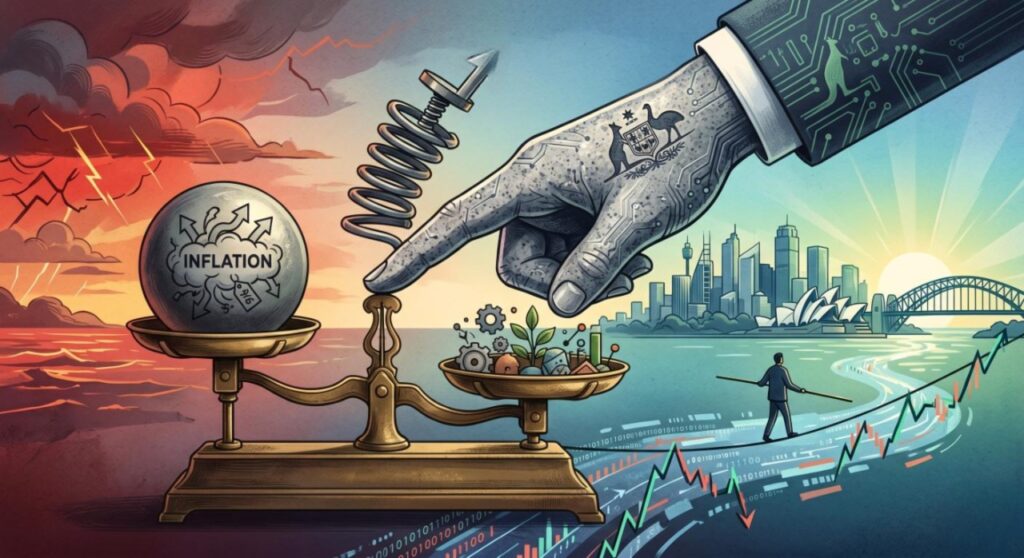
There is a particular kind of cruelty embedded in a central bank press conference where the governor tells millions of financially stretched households that, yes, rates are on hold — and then immediately adds that they could go up again.
That was precisely the atmosphere inside the Reserve Bank of Australia’s media room on Tuesday afternoon, June 16, 2026, when RBA Governor Michele Bullock stepped up to the podium and delivered what was, on its surface, welcome news: the cash rate would remain at 4.35 per cent. No change. No hike. A pause.
And then she kept talking.
“I want to be very clear that inflation remains too high,” Bullock said, her tone carrying the carefully calibrated firmness that has become a signature of her tenure. Rate hikes, she confirmed, remained on the table “if that is what is required to bring inflation down.” The board was “alert to upside risks,” she stressed. It would “do what it considers necessary,” she said, “including increasing the cash rate target further if required.”
The message to Australia’s 1.6 million mortgage-stressed households was unmistakable: breathe, but not too deeply.
This is the story of where Australia’s economy stands today — battered by a war it did not choose, squeezed by inflation it cannot fully control, and governed by a central bank that is simultaneously giving the country a reprieve and refusing to promise that the reprieve will last.
Part One: How We Got Here — Three Hikes, a War, and a Nation Under Pressure
To understand the significance of today’s decision, you have to understand the extraordinary monetary policy journey that Australia has undergone in 2026.
It is a journey that began with hope. Through the second half of 2025, the RBA had been in cautious easing mode. After successfully navigating the post-pandemic inflation surge with aggressive rate increases that pushed the cash rate to a cycle peak — and watching inflation slowly return toward the target band of 2 to 3 per cent — the board had begun cutting. Three reductions of 25 basis points each were delivered across 2025, bringing the cash rate down to 3.60 per cent by August of that year, where it sat, with considerable relief, through the end of the calendar year.
Then came 2026. And with it, a collision of forces that no model had adequately anticipated.
The first blow was domestic: an “unexpectedly marked upturn in inflation” in the third quarter of 2025, as the OECD described it, where year-on-year core inflation — as measured by the trimmed mean — picked up from 2.7 per cent back to 3.0 per cent, reversing the downward trend that policymakers had been counting on. The easing cycle that the market had celebrated was suddenly looking premature.
The second blow was global: the outbreak of the 2026 Iran War on February 28. When the United States and Israel launched large-scale military strikes on Iran, and Tehran responded by closing the Strait of Hormuz — the waterway through which roughly one-fifth of the world’s crude oil flows every day — the energy commodity complex exploded. Brent crude surged toward $120 per barrel. Australian petrol prices soared to record highs. Grocery bills inflated. Utility costs climbed. The construction and hospitality sectors, already under pressure, faced a fresh wave of input cost increases. The Consumer Price Index, which the RBA had been painstakingly guiding back toward target, began moving in the wrong direction.
The RBA’s response was forceful. In February 2026, the board hiked by 25 basis points, taking the cash rate from 3.60 per cent to 3.85 per cent. In March, it hiked again — another 25 basis points to 4.10 per cent, with the board voting 5 to 4 in a split decision, reflecting genuine internal division about the pace and necessity of tightening. And in May, it hiked a third time, adding a further 25 basis points to bring the cash rate to 4.35 per cent — the level at which it sits today.
In total, the RBA delivered 75 basis points of tightening in the space of roughly three months, reversing all the easing it had delivered in 2025 and then pushing materially beyond it. The reversal has been stunning in its speed. From a rate of 3.60 per cent as recently as January — where the market was anticipating further cuts — the cash rate has now risen to 4.35 per cent, the highest level in many years, at a pace that has caught many Australian households off guard and, by any honest assessment, has inflicted significant financial pain on those least equipped to absorb it.
Part Two: The June Decision — Unanimous, Expected, and Loaded With Caveats
Today’s decision to hold the cash rate at 4.35 per cent was, in one sense, entirely predictable. All four of Australia’s major banks — Commonwealth Bank, NAB, ANZ, and Westpac — had forecast a hold in the lead-up to Tuesday’s meeting. Financial markets had priced the decision as a near-certainty. The only real question was not whether the RBA would hold, but how it would talk about what comes next.
The answer, as Bullock’s press conference made clear, was carefully but unmistakably hawkish.
The board’s formal statement — read out alongside the rate announcement at 2:30 PM AEST, before Bullock fronted media at 3:30 PM — confirmed the decision was unanimous. It cited two primary reasons for the pause: first, the board wanted to assess the cumulative impact of the three hikes already delivered in 2026; and second, it wanted to evaluate the broader effect of the global oil supply disruption on the Australian economy, particularly in the context of the tentative U.S.-Iran peace deal announced just a day earlier on June 14-15.
“But inflation is still too high,” the statement said, “and the board judged that it was appropriate to leave the cash rate target unchanged while it assesses the response to previous interest rate rises and the impact of the oil supply disruption.”
Critically, the board included a forward guidance clause that left no room for complacency among mortgage holders or financial markets. “Monetary policy is well placed to respond to developments,” the statement read, “and the Board is focused on its mandate to deliver price stability and full employment. It will do what it considers necessary to achieve that outcome, including increasing the cash rate target further if required.”
The closing phrase — “increasing the cash rate target further if required” — was not accidental language. It was a deliberate signal, placed at the closing sentence of the formal statement, designed to ensure that no one interpreted a single hold as an all-clear.
At the press conference, Bullock reinforced the point. She noted that while the price of oil had eased in recent weeks following the preliminary U.S.-Iran agreement, related commodity prices remained higher than they were before the Middle East conflict began. She stressed that the resolution of the conflict was “still at an early stage” and that global oil supply issues would “take some time to resolve,” meaning energy prices and the inflation they generate would remain elevated for some period to come.
She also made a remark about the dangers of waiting too long — referencing what economists sometimes call “snapping the inflation stick”: the risk that inflation expectations become unanchored, forcing the central bank into a far more aggressive response than would have been necessary with earlier action. “You can’t wait until you see all the evidence you’re heading in the right direction,” Bullock said, “because it might be too late.”
The board, in other words, is not done. It is pausing. There is a difference.
Part Three: The Inflation Problem — Stubborn, Multidimensional, and War-Fuelled
To appreciate why the RBA remains so cautious, it is essential to understand the nature of the inflation challenge Australia currently faces. It is not a simple, single-source problem. It is a layered, multidimensional beast, and each layer responds differently to the blunt instrument of interest rate hikes.
The headline Consumer Price Index stood at 3.7 per cent in the 12 months to February 2026 — down from a peak of 3.8 per cent in January, but still significantly above the RBA’s 2-to-3 per cent target band and, more worryingly, moving in the wrong direction relative to the trajectory the board had been expecting when it began cutting in 2025. By April 2026, inflation was running at approximately 4.2 per cent.
The largest single contributor to annual inflation in recent months has been the Housing category, which rose 7.2 per cent — an extraordinary figure that reflects the combined pressures of elevated mortgage rates feeding into rental markets, strong population growth outpacing housing supply, and rising construction costs driven in part by energy price pass-through. The Australian property market has been a persistent source of inflationary pressure that interest rate hikes, counterintuitively, have struggled to contain in the way traditional monetary models would predict.
Research from the e61 Institute, an independent economic think-tank, has highlighted a structural reason for this: most Australian households with a mortgage do not react to higher interest rates by cutting household spending in the way that standard economic models assume. Instead, they tend to reduce or build up their so-called “mortgage buffers” — offset accounts and redraw facilities — rather than changing consumption patterns. This means that the transmission mechanism from RBA rate decisions to consumer spending is weaker in Australia than in many comparable economies, and that the housing market, with its combination of forced sellers being scarce, strong population growth, and limited supply, may not soften as much in response to higher rates as conventional wisdom would suggest.
That creates a painful paradox for the RBA: hiking rates is causing real hardship for many households, particularly those with limited savings buffers who are absorbing both higher mortgage repayments and higher fuel and grocery prices simultaneously — but the macroeconomic impact on the inflationary dynamics the central bank is trying to address may be less than the aggregate household pain would suggest.
The energy shock from the Iran War has complicated matters enormously. Fuel costs, grocery bills, and utility charges have risen simultaneously, concentrating financial stress on lower and middle-income households with limited buffer savings. A household carrying a $600,000 mortgage, a fuel-dependent commute, and no inflation-protected income is simultaneously absorbing higher interest payments, higher pump prices, and higher grocery costs. No single policy response provides relief across all three pressure points at once. The three rate hikes delivered so far in 2026 have added approximately $300 per month to the repayments on a standard $600,000 variable-rate home loan, compounding onto a cost-of-living shock that was already among the worst in recent memory.
Treasurer Jim Chalmers has publicly attributed much of the household cost burden to the geopolitical conflict’s economic spillover, framing the government’s temporary fuel excise relief as a targeted offset rather than a structural solution. That framing is technically accurate, but it provides cold comfort to households whose budgets are stretched thin. The question of whether that fuel excise relief — which is set to expire at the end of the month — will be extended remains, as of today, unresolved, with Chalmers describing it as “under review.”
Against this backdrop, Australia’s GDP data has added a further wrinkle. The economy expanded by 2.5 per cent in the first three months of 2026 on a year-on-year basis — missing expectations and matching the rate of the prior quarter. On a quarter-on-quarter basis, growth was just 0.3 per cent. That is not the profile of a roaring economy that needs aggressive monetary restraint; it is the profile of an economy that is slowing, under pressure, and susceptible to tipping into something more serious if policy is tightened too far or too fast.
The RBA is navigating what central bankers sometimes call the “soft landing” challenge at its most acute: trying to bring inflation back to target without crushing an economy that is already showing signs of stress. The three hikes delivered this year have been the aggressive phase of that response. Today’s hold is the reassessment phase.
Part Four: The Big Four Banks Diverge — A Rare Split on the Path Ahead
One of the more striking features of the post-decision landscape is the degree to which Australia’s four major banks — usually aligned on the broad direction of RBA policy, if not always on precise timing — have diverged in their forecasts for what comes next.
Three of the four — Commonwealth Bank of Australia, NAB, and ANZ — are forecasting a rate cut at the August meeting, the next scheduled policy decision on August 11. Their view, broadly speaking, is that the combination of slowing growth, the potential resolution of the Iran conflict and the resulting easing of energy prices, and the cumulative impact of the 75 basis points of tightening already delivered this year will be sufficient to bring inflation back toward the target range over the course of 2026, and that the RBA will have the confidence to begin easing before year-end.
NAB Chief Economist Sally Auld has put the bank’s position with characteristic precision: “We have greater conviction that the next move in rates is down, but less conviction on the timing.” It is a formulation that captures the genuine uncertainty of the moment — the direction of travel is becoming clearer, but the road remains bumpy.
Westpac, however, sits in a starkly different camp. The bank is forecasting not one but two further rate hikes — in August and September — before any easing is contemplated. That view implies a peak cash rate of 4.85 per cent, a level that would represent the most aggressive tightening cycle in many years and would add further substantial pressure to Australian household budgets.
The divergence between the three “cut in August” camps and Westpac’s “hike twice more” forecast reflects a genuine intellectual debate about several key variables: How quickly will the energy price shock from the Iran War wash out of the CPI data? Will the tentative U.S.-Iran peace deal hold, and if so, how fast will it translate into lower domestic fuel prices? Is the RBA’s reading of underlying inflationary momentum — as opposed to the oil-driven headline figure — consistent with a return to target, or does the persistence of non-oil inflation require further monetary tightening?
The RBA’s own board discussed whether to hike at today’s meeting before deciding to stay the course on a hold — a revelation that Bullock disclosed at the press conference. She was careful to add that she “would not say that the case for a rate hike is increasing,” and that the board’s use of the word “vigilant” in its communications “does not mean an interest rise is coming.” But the fact that a hike was on the table at today’s meeting — not just as a theoretical possibility but as a live option actively debated by the board — suggests that Westpac’s hawkish scenario is not as outlier as the market might wish.
PRD chief economist Dr Diaswati Mardiasmo offered a more sanguine interpretation of the board’s calculus: “They also don’t like to change the cash rate around the time of federal budget announcements so they can keep everyone on a level playing field. They want to provide some stability to households for at least three months so they can have the same monthly mortgage repayments.” She believes the RBA is holding fire until the release of the June quarter CPI data, due at the end of July, which will be available in time for the August board meeting and will provide the cleanest read yet on whether the inflation trajectory is bending back toward target.
The next meeting is scheduled for August 11, 2026. Between now and then, the key data points to watch are: the June quarter CPI figures (due late July), monthly labour force data, consumer sentiment surveys, and — critically — the progress of the U.S.-Iran nuclear negotiations, which will determine whether the energy price shock that has driven so much of Australia’s 2026 inflation episode is genuinely resolved or merely paused.
Part Five: The Iran Factor — A War Australia Did Not Fight but Is Paying For
Perhaps the most extraordinary dimension of Australia’s 2026 monetary policy story is that a significant portion of its inflation problem has been imported from a conflict on the other side of the world — a war between the United States, Israel, and Iran, in which Australia played no direct military role, but the economic consequences of which have arrived on the doorstep of every Australian household with a car, a gas bill, or a mortgage.
The connection runs through the Strait of Hormuz. When Iran closed that waterway in late February following the outbreak of the war, it did not merely disrupt oil flows to Europe and Asia. It sent a price shock through every energy-linked commodity in the global market. In Australia — a country that is a net energy exporter in aggregate but a significant importer of refined petroleum products for domestic consumption — the impact was rapid and pronounced. Petrol prices surged. Diesel prices climbed. Electricity prices followed, because Australia’s gas-fired power generation is tied to global LNG markets that are themselves tied to the crude oil complex.
The RBA’s formal statement today acknowledged this dynamic directly, noting that “while the price of oil has eased in recent weeks, the related commodity prices are still higher than they were before the conflict in the Middle East began.” The board’s statement specifically said it was “assessing the response to previous interest rate rises and the impact of the oil supply disruption” — framing the Iran War’s economic consequences as a central factor in its decision-making.
The tentative peace deal announced on June 14-15 — a memorandum of understanding between the U.S. and Iran brokered by Pakistan, calling for simultaneous lifting of Iran’s Strait of Hormuz closure and the U.S. naval blockade of Iranian ports — has already produced some relief. Oil prices fell approximately 5 per cent on the deal announcement. If the formal signing scheduled for Friday in Switzerland goes ahead and the ceasefire holds, further price relief could follow as global oil supply normalises and the war risk premium is unwound.
But the RBA is not taking that for granted. The board’s statement stressed that the resolution of the conflict remains “at an early stage.” The formal peace deal has not yet been signed. The harder question of Iran’s nuclear program — which is at the root of the entire conflict — is deferred to a 60-day negotiation period that begins after Friday’s signing. There are active tensions between Israel and Hezbollah in Lebanon that could destabilise even the preliminary ceasefire. And there is a history, in this particular conflict, of ceasefires announced, celebrated, and then collapsed within days.
The board also noted its concern about something more insidious than the immediate oil price: the risk that inflation “becomes embedded” even after the oil price impulse passes through. This is the phenomenon central bankers fear most — the moment when workers start demanding higher wages to compensate for higher prices, and businesses start routinely pricing those higher costs into their goods and services, creating a wage-price spiral that takes years and deep recessions to break. Australia has not reached that point. Wages growth appears, as the board noted, “to have peaked.” But it remains “above the level that can be sustained given trend productivity growth” — meaning the labour market is still generating inflationary wage dynamics that complicate the path back to the 2-to-3 per cent target.
Bullock’s remark about “snapping the inflation stick” — the risk of waiting too long — is, at its core, a warning about exactly this dynamic. The longer above-target inflation persists, the greater the risk that it becomes embedded in expectations, requiring a far more aggressive and economically painful monetary response later. It is the ghost of the 1970s, haunting every central bank governor who has studied monetary history.
Part Six: The Human Cost — 1.6 Million Households Under Mortgage Stress
Behind every basis point of central bank rate policy is a family. And the human cost of Australia’s 2026 tightening cycle is, by any measure, severe.
Approximately 1.6 million Australian households are estimated to be under mortgage stress — a level not seen since the most aggressive phase of the post-GFC tightening cycles. For many of these households, the 75 basis points of rate increases delivered in February, March, and May 2026 have translated directly into approximately $300 per month in additional mortgage repayments on a $600,000 loan. On a $700,000 loan, the cumulative increase since January is closer to $215 to $350 per month depending on the product. Those numbers compound on top of fuel bills that have surged more than 20 per cent since the start of the year, grocery costs that have climbed significantly, and utility costs that have risen alongside energy market pressures.
The savings accounts of many households — built up during the low-rate years of the pandemic and gradually deployed to absorb the earlier rate increases — have been depleted more rapidly than analysts anticipated. Research from the OECD has highlighted how Australia’s high prevalence of variable-rate mortgages makes it particularly sensitive to monetary policy tightening: while the slowdown in private demand growth may have been “less pronounced” in some comparable economies with more fixed-rate products, the speed with which higher rates translate into reduced discretionary spending for Australian mortgage holders is more direct and more immediate.
For renters, the picture is equally grim. Housing inflation — running at 7.2 per cent on a year-on-year basis — reflects in part the pass-through of higher mortgage costs to rental prices, as landlords seek to cover their increased borrowing expenses. Strong population growth in Australia’s major cities has kept rental demand elevated even as affordability has deteriorated sharply. Vacancy rates in Sydney and Melbourne remain historically low.
The Treasurer’s temporary fuel excise relief, set to expire at the end of June, has provided some marginal offset to household budgets. But it has not changed the fundamental picture of a household sector that is absorbing multiple simultaneous cost shocks and is, in many cases, approaching the limits of what it can sustain without significant behavioural change.
Today’s hold, and the prospect of a rate cut in August if the data cooperates, will provide a degree of psychological relief to these households. But no economist is predicting that mortgage rates will fall back to the levels of 2024 and 2025 anytime soon. The highest savings rates in the market are currently around 5.75 per cent per annum (for accounts meeting various conditions), and the highest term deposit rate is 5.70 per cent — numbers that represent genuine value for savers, but that tell a story about an interest rate environment that has been substantially repriced relative to the recent past.
Part Seven: The Australian Dollar and Market Reaction
The market reaction to today’s decision was swift and, in the context of the RBA’s hawkish tone, somewhat paradoxical. The Australian S&P/ASX 200 was marginally lower following the decision — reflecting investor uncertainty about the path ahead — while the Australian dollar weakened 0.3 per cent against the U.S. dollar to trade at 0.705. That modest depreciation suggests the market had, on balance, expected a slightly more dovish tone from Bullock, or had priced in a lower probability of further hikes than the governor’s remarks now imply.
In currency markets, the AUD/USD pair had been trading around the 0.705-0.710 level in the lead-up to the decision, buoyed by commodity currency tailwinds from elevated energy prices and firmer iron ore markets. The slight weakening post-decision suggests currency traders read the board’s statement as incrementally more bearish on the Australian economic outlook — slower growth, prolonged inflation, and an uncertain rate path — than they had anticipated.
Bond markets, too, will be parsing the statement carefully. The 2-year Australian Government bond yield — the most sensitive to near-term rate expectations — will be a key indicator to watch in the sessions following the decision. If Westpac’s hawkish forecast of two more hikes gains traction, yields at the short end of the curve should push higher. If the three-bank consensus view of a cut in August proves more persuasive, the curve could begin to steepen.
The financial markets were, as IG analyst Tony Sycamore noted ahead of the decision, “pricing in about a one-in-two chance of one more rate rise in 2026.” That probability will be reassessed in the hours and days following today’s press conference, as traders and analysts digest every word of Bullock’s remarks.
Part Eight: The Path Forward — Data Dependency at Its Most Literal
If there is a single phrase that best captures the RBA’s posture as of June 16, 2026, it is this: data dependent. Not in the anodyne, bureaucratic sense in which central banks have sometimes deployed that phrase as a way of saying nothing, but in the most literal and consequential sense — the next decision will depend entirely on what the incoming data shows.
The board did not consider a rate cut at today’s meeting. It confirmed this explicitly. But it also stopped short of committing to a hike. The board’s statement explicitly said it was “not ruling anything in or out” — a phrase with echoes of earlier Bullock communications and one that is carefully calibrated to maintain maximum optionality while providing minimum forward guidance.
The variables that will determine the August decision are now clearer than they have been at any point this year. They are, in rough order of importance: the June quarter CPI data, due in late July; the trajectory of global oil prices, which will be heavily influenced by whether the U.S.-Iran peace deal is formalised and whether the Strait of Hormuz reopens on schedule; the domestic labour market data, including wage growth trends; and any significant shift in global financial conditions, including U.S. Federal Reserve policy and the direction of China’s economy.
On that last point, it is worth noting that Australia’s economy is not insulated from global monetary policy trends. The Fed, the Bank of Canada, the European Central Bank, and central banks across Asia-Pacific have all been grappling with the same energy-driven inflation shock from the Iran War. AMP’s chief economist has warned that “coordinated global tightening in response to the same supply shock risks amplifying the growth contraction beyond what any single central bank intends.” If major central banks simultaneously tighten in response to a supply shock — rather than a demand shock — the risk of a globally synchronized slowdown deepens.
For Bullock and the RBA board, the most optimistic path from here looks something like this: the Iran peace deal holds, the Strait of Hormuz reopens fully, global oil prices normalise toward $70-$80 per barrel by September, the June quarter CPI data shows a meaningful deceleration in underlying inflation, and the three rate hikes already delivered this year are sufficient to bring inflation sustainably back toward the top of the 2-3 per cent band by late 2026. In that scenario, the board cuts in August and perhaps again before year-end, and 4.35 per cent marks the peak of the 2026 cycle.
The more challenging path — Westpac’s scenario, effectively — involves the Iran situation remaining fragile, energy prices staying elevated, underlying inflation (excluding oil) proving more persistent than hoped, and the board concluding that it cannot afford the risk of “snapping the inflation stick” and delivering one or two more hikes to ensure the inflationary dynamics are genuinely broken.
Neither path can be ruled out. The uncertainty is real, and it is profound.
Conclusion: A Pause That Is Not a Promise
The Reserve Bank of Australia’s decision on June 16, 2026 to hold the cash rate at 4.35 per cent is, in the most precise terms, exactly what it appears to be: a pause for breath, a moment of assessment, a deliberate act of restraint before the next chapter of Australia’s monetary policy story is written.
It is not a pivot. It is not a signal that the tightening cycle is over. It is not, Governor Michele Bullock was at pains to make clear, any kind of guarantee that rates will not rise again. It is a single hold in a sequence that has so far included three hikes, and which could include more before it includes any cuts.
For the 1.6 million Australian households under mortgage stress, that distinction is not merely semantic. It is the difference between planning for a fixed, stable budget and planning for a budget that could be upended again in eight weeks. It is the difference between a stressful situation that is manageable and a stressful situation that is about to become worse.
Australia’s inflation story in 2026 has been, in large part, a story of being caught in the crossfire of someone else’s war. The Iran conflict — launched by the United States and Israel, felt in petrol stations from Perth to Cairns — has been the single largest driver of the RBA’s return to tightening and the single largest source of household cost pressure in a year that was supposed to be one of gradual easing and relief.
That conflict may now be ending. The ships, as President Trump declared on Sunday, have been told to start their engines. The Strait of Hormuz may be on the verge of reopening. Oil prices may be on a path back toward levels that do not require the RBA to keep its finger hovering over the rate hike button.
But “may be” is not “is.” And Michele Bullock, who has staked the credibility of her tenure on a commitment to not letting inflation become embedded, is not in the business of betting the institution’s reputation on geopolitical ceasefires that have not yet been formally signed, let alone durably enforced.
The hawk, in other words, is standing at the edge of its perch. It has not flown. But it has not left either.
The next eight weeks — and the data they bring — will determine whether it finally returns to its nest, or launches once more into the sky.
This journal narrative has been compiled from current reporting by CNBC, SBS News, Yahoo Finance Australia, Domain, Savings.com.au, the Newcastle Herald, the Southern Cross, Aussie Home Loans, and other sources as of Tuesday, June 16, 2026, the date of the RBA’s June monetary policy decision. It is intended as journalistic analysis and does not constitute financial or investment advice. Any decisions regarding mortgages, savings, or investment products should be made with the guidance of a licensed financial adviser.