
A WORLD UNITED BY ONE BALL:The 2026 FIFA World Cup and the Dawn of Football’s Greatest Era

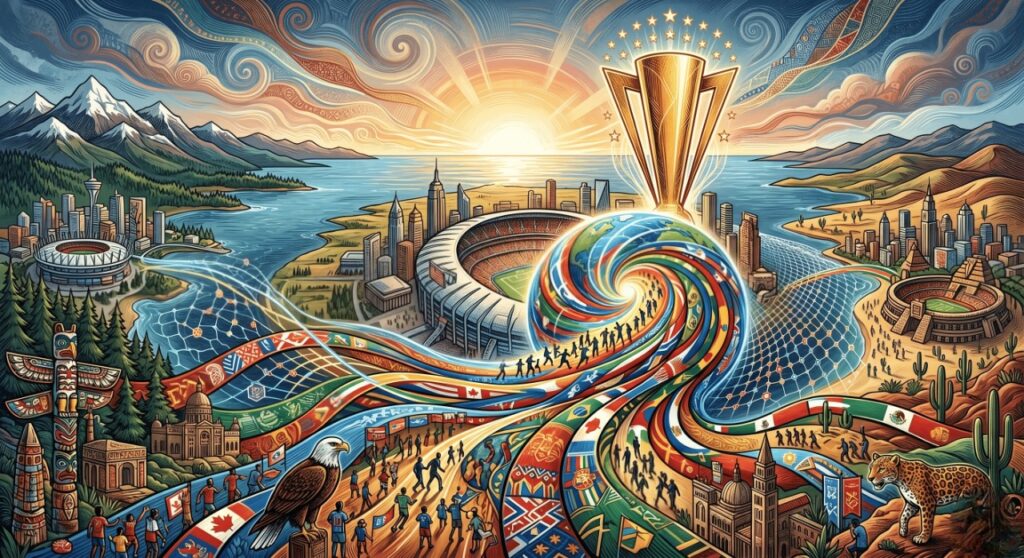
I. PRELUDE TO HISTORY: THE MAKING OF THE MOST AMBITIOUS WORLD CUP There are moments in the history of sport when an event transcends its own competition and becomes something far larger — a mirror held up to the human condition, reflecting our shared hunger for glory, belonging, and meaning. The 2026 FIFA World Cup is one such moment. Before the first whistle blew at the Estadio Azteca in Mexico City on June 11, 2026, football’s governing body had already made history simply by organizing a tournament of such extraordinary scale that the logistics alone required years of multinational diplomacy, billions of dollars of investment, and the coordinated will of three of the world’s most powerful sporting nations.
To understand how the 2026 World Cup came to be, one must journey back to 2017, when FIFA’s member associations voted to expand the tournament from its long-established 32-team format to an unprecedented 48. The decision was simultaneously pragmatic and visionary. Pragmatic, because the expansion allowed football’s governing body to include more of the world’s footballing nations in its most prestigious competition — a measure of democratization in a sport that had long been criticized for privileging established European and South American powers. Visionary, because it acknowledged what any football fan knows intuitively: that the game’s greatest stories are not always written by the favorites.
A year later, in 2018, at FIFA’s 68th Congress held in Moscow, a pivotal vote was cast. The United States, Canada, and Mexico — who had initially announced plans to present individual bids for the 2026 hosting rights — had taken the strategic decision to present a joint bid under the slogan ‘United As One.’ Their combined proposal proved irresistible, securing 67 percent of the 200 votes cast against a rival bid from Morocco. The decision was rational on almost every measurable metric: all stadiums were already built, required no major new construction, and boasted an average capacity exceeding 68,000 fans. With 104 matches to organize, it was practically impossible for any single nation to absorb the logistical demands of such a tournament on its own.
“With 48 teams and three host nations, the 2026 World Cup isn’t just a bigger tournament — it’s a fundamentally different kind of World Cup.”
The significance of the tri-nation hosting arrangement cannot be overstated. This is the first men’s World Cup since the 2002 Japan-South Korea edition to be co-hosted by multiple nations — and the first in the competition’s entire 96-year history to span three countries simultaneously. It is also the first time a World Cup has been hosted in North America since the United States’ solo edition in 1994, a tournament that left a complex but ultimately formative legacy in American football culture. Mexico, meanwhile, achieves a distinction no other nation has ever reached: the first country to host or co-host the men’s World Cup three times, having previously staged the tournament in 1970 and 1986.
II. THE ARCHITECTURE OF AN EPIC: FORMAT, STRUCTURE, AND SCALE Numbers alone cannot capture the ambition of the 2026 World Cup, but they are a necessary starting point for any honest accounting of the tournament’s scale. The competition features 48 national teams — 16 more than any previous edition. These teams are distributed across 12 groups of four, with each nation playing three group-stage matches. From these 12 groups, 32 teams advance to the knockout stages: the top two from each group, plus the eight best third-place finishers. What follows is a straight single-elimination bracket from the Round of 32 through to the final, which introduces an entirely new round of knockout competition compared to all previous editions of the World Cup held since 1998.
The mathematical consequences of this expansion are staggering. The 2026 tournament will feature 104 matches in total — 40 more than the 64-match format that defined the Qatar 2022 edition and every World Cup from 1998 to 2022. With more matches comes more time: where previous tournaments lasted approximately 32 days, the 2026 edition spans 39 days from opening kickoff to the final whistle at the New York New Jersey Stadium on July 19. Teams that advance all the way to the final will need to win as many as eight matches — a greater endurance test than any previous World Cup champion has faced.
The 16 host cities span three countries and represent a geographic canvas of extraordinary breadth. Eleven American cities serve as primary venues: New York/New Jersey (site of the final at MetLife Stadium, temporarily rebranded as New York New Jersey Stadium), Los Angeles (hosting games at SoFi Stadium, one of the world’s most advanced sporting arenas at its $5.5 billion construction cost), Dallas, San Francisco/Bay Area, Seattle, Atlanta (at Mercedes-Benz Stadium, hosting eight matches including a semifinal), Boston, Miami, Kansas City, Houston, and Philadelphia. Three Mexican cities — Mexico City (home of the iconic Estadio Azteca), Guadalajara, and Monterrey — provide the tournament with its historical anchor and Latin football soul. Canada contributes two cities: Toronto and Vancouver, marking the country’s first-ever World Cup hosting experience.
The Unprecedented Knockout Structure
Perhaps the most consequential structural change in the 2026 format — beyond the raw expansion of teams — is the creation of the Round of 32, a new knockout round that inserts an entirely additional elimination phase between the group stage and the traditional Round of 16. In all World Cups from 1986 through 2022, 16 teams advanced from the group stage to a Round of 16. In 2026, 32 teams advance, meaning the first knockout round now involves 32 nations competing in 16 matches before the field is halved to 16 for the quarterfinals.
This innovation has profound implications for the competitive dynamics of the tournament. It provides a safety net for strong teams that stumble in the group stage — nations that might have been eliminated in previous years due to a single poor performance now have an additional lifeline. It also creates an entirely new set of high-stakes, winner-takes-all clashes in the early knockout rounds, potentially featuring matchups between traditional football powers that would previously have only occurred in the quarterfinals or semifinals. Critics of the expanded format have suggested this dilutes the purity of the competition; proponents argue it creates more football, more drama, and more opportunities for the unexpected.
FIFA has also introduced an innovative anti-collusion safeguard into the competition’s design. Two separate brackets have been created for the semifinal stages, structured in such a way that the two highest-ranked teams in the tournament cannot meet before the final, should they both win their respective groups. This architectural choice reflects a sophisticated understanding of competitive balance and narrative tension — the organizers are, in a very real sense, engineering the conditions for a more compelling story.
— ✦ —
III. THREE NATIONS, ONE STAGE: THE GEOPOLITICS OF CO-HOSTING
To host a World Cup is to make a statement about who you are as a nation, and what you believe football means to the world. To co-host a World Cup across three nations simultaneously is to make a far more complex and fascinating statement — one about cooperation, shared identity, and the idea that the beautiful game belongs not to any single country or culture, but to all of humanity.
The United States brings to the 2026 World Cup the sheer gravitational force of its economic and infrastructural might. American stadiums, many of which were built for American football and have been adapted for the occasion, are among the largest and most technologically sophisticated sporting venues on Earth. MetLife Stadium in East Rutherford, New Jersey — temporarily rebranded as New York New Jersey Stadium for the competition — will host the tournament’s final, continuing a tradition of American arenas serving as the backdrop for football’s ultimate moment that stretches back to the Rose Bowl in Pasadena, which hosted the 1994 World Cup final. The stadium has undergone significant renovation to meet FIFA standards, including new pitch technology and expanded media facilities. SoFi Stadium in Los Angeles, which required minimal upgrades given its already world-class infrastructure, has already established itself as one of the great sporting venues on the planet.
For Mexico, the 2026 World Cup is a homecoming freighted with historical significance. The Estadio Azteca in Mexico City — the only ground to have hosted two World Cup finals, in 1970 and 1986 — stands as perhaps the most mythologized football stadium on Earth. Its terraces witnessed Diego Maradona’s Hand of God and Goal of the Century in 1986; its atmosphere has reduced opposition teams to paralysis and inspired Mexican supporters to flights of collective ecstasy. Hosting a third World Cup gives Mexico the opportunity to cement its identity as a nation inextricably woven into the fabric of football history — not merely as a participant, but as a guardian of the game’s most sacred spaces.
Canada’s role in the 2026 World Cup is, in many ways, the most historically resonant of all three co-hosts. Canadian football — soccer, as it is known domestically — has long existed in the shadow of the country’s dominant sporting passions: ice hockey above all, but also Canadian football, basketball (where Canada has produced some of the NBA’s greatest talents), and increasingly, other global sports. The country had never hosted a men’s World Cup before 2026, and its own national team’s qualification for the tournament as a co-host represents the beginning of what many observers hope will be a transformative era for the sport in Canada. Cities like Toronto and Vancouver, both cosmopolitan metropolises with large immigrant populations for whom football is not a curiosity but a primary identity, are expected to produce some of the most electric atmospheres of the entire tournament.
“For Canada, the 2026 World Cup is not merely a sporting event — it is a declaration that football belongs here, too.”
The political context in which the 2026 World Cup takes place is impossible to ignore. The tournament is being held in an America marked by the political currents of the Trump administration — currents that have generated real tension around the event. Trump’s travel bans have reportedly prevented some fans and officials from attending matches. Reports have emerged of Immigration and Customs Enforcement agents being present at game venues, creating anxiety among immigrant communities for whom the World Cup represents one of their most cherished cultural touchstones. There has also been significant controversy over soaring ticket prices, which critics argue have placed the tournament beyond the financial reach of many ordinary fans in the host countries.
These tensions are real, and they matter. A World Cup that preaches global unity while simultaneously restricting access based on national origin creates a profound moral dissonance that no amount of ceremonial rhetoric can fully dissolve. The 2026 World Cup must reckon with this contradiction honestly, even as it celebrates the extraordinary achievement of bringing the entire footballing world to North America for the first time in three decades.
IV. THE ECONOMICS OF MAGNITUDE: INVESTMENT, IMPACT, AND LEGACY
The financial dimension of a World Cup of this magnitude is almost incomprehensible in its scale. FIFA projects that the 2026 tournament will generate approximately $40.9 billion in gross domestic product across North America — a figure that dwarfs the economic footprint of any previous World Cup edition. Individual host cities are expected to see between $160 million and $620 million in incremental economic activity, with those hosting knockout rounds — which attract fans for longer stays and command premium ticket prices — positioned to capture the largest share of visitor spending.
One of the most striking economic characteristics of the 2026 World Cup is its cost efficiency relative to previous editions. Unlike Qatar’s 2022 tournament, which required the construction of entirely new stadiums and substantial new city infrastructure at a cost estimated at $220 billion, the 2026 hosts are leveraging existing world-class facilities. Over $1.5 billion in stadium upgrades and surrounding infrastructure improvements are underway across the 16 venues, but this figure is a fraction of what purpose-built hosting has historically demanded. Independent analysts estimate the tournament’s return on investment at a ratio of 7.3 times — by far the highest in modern World Cup history. The broader economic multiplier effects — from hotel occupancy rates to restaurant revenues, transportation demand, retail sales, and tourist attraction visits — are expected to ripple through host city economies for months after the final whistle blows.
The Jobs Question: Opportunity and Skepticism
The tournament is projected to create approximately 150,000 temporary jobs directly related to World Cup operations, with some estimates suggesting that when indirect employment effects — suppliers, logistics companies, food producers, merchandisers, and service providers throughout the supply chain — are included, the true figure could exceed 250,000 positions across the three host countries. Ride-sharing giants Uber and Lyft have estimated that demand for their services will increase three to four times in host cities on match days, generating significant additional income for their drivers.
Yet the economic narrative is not without its critics. Independent academic research, including a study commissioned by Smith College Professor Emeritus Andrew Zimbalist, has raised pointed questions about the distribution of World Cup economic benefits. The research notes that host cities bear very significant costs — including public safety expenditures that can exceed $100 million per city — while FIFA, as the tournament’s organizing body, captures the vast majority of commercial revenues. Research from the University of Toronto found that 12 of the last 14 World Cups resulted in net economic losses for host cities. Toronto’s council-approved FIFA World Cup budget stands at $380 million, supported by contributions from the federal and provincial governments, but the ultimate balance between costs and returns remains uncertain.
Foxborough, Massachusetts — a small town of 18,000 residents whose Gillette Stadium (temporarily rebranded as Boston Stadium) is hosting seven World Cup matches — has faced particularly acute scrutiny over its preparations. Local officials have raised concerns about traffic management, transit system strain, and the approximately $7.8 million in local public safety costs generated by the tournament’s presence. These concerns are not unique to Foxborough: they reflect a broader pattern in which the extraordinary scale of a World Cup creates logistical pressures that existing municipal infrastructure was never designed to absorb.
The social justice dimension of the tournament’s economic footprint also demands attention. In Atlanta, where Mercedes-Benz Stadium is hosting eight matches including a semifinal, investigative reporting by Reuters has revealed that city workers have dismantled numerous encampments housing unhoused individuals in and around downtown in the two years preceding the tournament. Advocates for homeless communities have warned that World Cup preparations reproduce a familiar pattern: treating poor and vulnerable people as obstacles to the image a host city wishes to project to the world. Kansas City, which hosts six matches including a quarterfinal and has been promised 650,000 visitors and more than $650 million in economic impact, faces similar questions about who benefits when the world arrives — and who is left behind.
— ✦ —
V. NEW VOICES ON THE GLOBAL STAGE: THE TOURNAMENT DEBUTANTS
Among the most compelling narratives of the 2026 World Cup is the story of the four nations making their first-ever appearances at football’s premier competition: Cabo Verde, Curaçao, Jordan, and Uzbekistan. Their qualification represents both the individual achievement of football programs that have worked for decades toward this moment, and a structural shift in the architecture of global football made possible by the 48-team expansion.
Cabo Verde: The Blue Sharks Arrive
Cabo Verde — the island archipelago nation off the western coast of Africa with a total population of approximately 525,000 — has qualified to become the third-least populous nation in World Cup history, behind only Curaçao and Iceland. Their road to North America was forged through a qualifying campaign of remarkable consistency: the Blue Sharks, as Cabo Verde’s national team is known, lost only one of their ten qualifying matches and navigated a group that included African football heavyweights Cameroon. Their qualification was sealed in style with a 3-0 victory over Eswatini in October 2025, a match that sparked celebrations across the islands and throughout the vast Cabo Verdean diaspora scattered across Europe, the Americas, and Africa.
Cabo Verde’s story is inseparable from the story of migration. Cabo Verdean communities in Portugal, the Netherlands, and the United States have maintained passionate connections to the national team through decades during which World Cup qualification seemed a distant dream. The 48-team expansion has not simply opened a door for Cabo Verde — it has redeemed years of hope, investment, and identity that small island communities had placed in a team that the old format could not accommodate.
Curaçao: The Smallest Nation, The Biggest Dream
Curaçao, a small Caribbean island with a population smaller even than Cabo Verde’s, has achieved what the island’s football community long considered beyond reach. The Blue Family — Curaçao’s national team — built their qualification campaign on a foundation of players with Dutch heritage, leveraging the island’s colonial links to the Netherlands to attract players of Caribbean descent who hold dual nationality and the experience of playing in some of Europe’s top football leagues. The appointment of veteran Dutch manager Dick Advocaat as head coach provided the tactical structure and international credibility to match this diaspora talent pool.
Curaçao’s qualification carries significance that extends beyond football. For a Caribbean island of modest size and limited global visibility, appearing in a World Cup represents an opportunity to announce its existence to billions of viewers who might never otherwise have reason to learn about its culture, history, and people. The economic and cultural tourism benefits alone could be transformative for a small island economy.
Jordan: The Middle East’s New Football Power
Jordan’s qualification for the 2026 World Cup is a testament to the rapidly growing competitiveness of Asian football and, specifically, the emergence of Middle Eastern nations as credible competitors at the international level. Jordan has long been a nation of passionate football supporters — the game is deeply embedded in Jordanian culture and identity — but the national team has historically fallen short in the final stages of Asian qualifying. Their breakthrough in 2026 reflects genuine improvement in coaching standards, youth development infrastructure, and player quality across the region.
Jordan becomes one of the very few Middle Eastern nations to qualify for a World Cup through the traditional competitive route, rather than through automatic qualification as a host nation — a distinction that lends their achievement particular credibility. Their presence underscores how the Asian Football Confederation’s member associations are closing the competitive gap with established regional powers like Japan, South Korea, and Australia, and beginning to challenge on the global stage in ways that were difficult to foresee even a decade ago.
Uzbekistan: Central Asia’s Pioneer
Uzbekistan’s qualification represents perhaps the most remarkable story of football development among the 2026 debutants. The Central Asian nation — which became the first country from that region ever to qualify for the men’s World Cup — has pursued a systematic and patient long-term investment in football that is beginning to yield extraordinary results. Uzbekistan won the Under-17 Asian Cup in April 2025 and the Under-20 Asian Cup in 2023, building a pipeline of talented young players who will represent the foundation of the national team for years to come. The country also qualified for the Olympic Games for the first time in its history in 2024.
Uzbekistan’s rise is not the product of fortunate circumstance or the expanded tournament format alone — it reflects deliberate institutional investment in youth football, coaching education, and infrastructure development. Their presence in North America sends a powerful signal to football federations across Central and Southeast Asia that World Cup qualification is achievable with the right long-term commitment, regardless of historical pedigree.
“Four new nations at the World Cup. Four stories of perseverance, identity, and the democratic promise of football at its best.”
The record for World Cup debutants in a single tournament, excluding the inaugural 1930 edition, stands at six — established at Germany 2006, when Angola, Ivory Coast, Ghana, Togo, Trinidad and Tobago, and Ukraine all made their bows. With four debutants, 2026 falls short of that mark, but the symbolic weight of these four nations’ participation — in a world where the global football community has never been more aware of the need to broaden the game’s representational horizons — carries its own historic significance.
— ✦ —
VI. THE FAMILIAR POWERS AND THE RENEWED HUNT FOR GLORY
The expanded field has not diminished the stature of football’s traditional powers — if anything, it has sharpened their focus. Argentina arrive in North America as defending World Cup champions, having ended their 36-year wait for the trophy in Qatar with a final against France that many observers have already placed among the greatest matches in the competition’s history. Lionel Messi — widely regarded as the greatest footballer of his generation, and by many the greatest who has ever played the game — completed his quest for the one major honor that had eluded him, transforming his already extraordinary legacy into something approaching sporting mythology.
France, despite losing that Qatar final, arrive in 2026 as one of the tournament’s most formidable forces, buoyed by the brilliance of Kylian Mbappé — who has already announced his presence in the tournament with a performance of signature quality in the group stage. Brazil, present as always (the Selecao have appeared in every single men’s World Cup since the tournament’s inception in 1930), carry the weight of their five world titles and the perpetual expectation of their supporters, who regard anything less than the trophy as a failure of national promise. Spain, the reigning European champions — having won Euro 2024 to add to their 2010 World Cup and their 2008 and 2012 European Championship victories — enter as one of the tournament’s most compelling favorites.
The notable absence from the 2026 field is Italy, a four-time world champion whose failure to qualify represents one of the competition’s most stunning recurring narratives. The Azzurri’s absence is made all the more remarkable by the fact that this marks not the first or second but the third consecutive World Cup from which they have been excluded — a prolonged crisis of talent, identity, and institutional management that Italian football’s governing bodies are only beginning to address seriously.
With 32 teams advancing to the knockout rounds instead of 16, the path to the final demands a greater volume of quality performances than any previous World Cup champion has been required to produce. Teams must win as many as eight consecutive matches to lift the trophy — a test of squad depth, physical resilience, tactical adaptability, and psychological fortitude that has no precedent in the competition’s history. Whether this structural change will favor the established powers — who tend to possess deeper squads and more experienced coaching staffs — or create additional openings for ambitious challengers from football’s second tier remains one of the tournament’s most fascinating open questions.
VII. THE GLOBAL AUDIENCE AND THE CULTURAL FOOTPRINT
The 2026 FIFA World Cup is expected to reach a global television audience of approximately five billion viewers — a number that represents roughly 62 percent of the entire human population. No other regularly staged sporting event comes close to this scale of collective attention. The Olympic Games, in their summer and winter editions, attract significant global audiences, but the World Cup’s combination of a single sport, a clear competitive narrative, and deep cultural resonance across almost every inhabited corner of the planet creates a viewing proposition that is genuinely without parallel in the history of human entertainment.
The cultural significance of the 2026 edition’s North American setting cannot be overstated in this context. The United States — despite the professional football league’s modest position in the hierarchy of American sports compared to the NFL, NBA, MLB, and NHL — commands an extraordinary media infrastructure that the World Cup can leverage to reach audiences that might previously have engaged only superficially with the game. The country’s broadcast media, digital platforms, and social media ecosystems are among the world’s most powerful amplifiers of narrative; a World Cup contested on American soil, with the United States men’s national team as a genuine competitive participant, has the potential to deepen the sport’s roots in American culture in ways that the 1994 World Cup — which helped establish Major League Soccer — only began to achieve.
The host nation’s own competitive trajectory adds additional narrative richness. The United States opened their group stage campaign with a commanding 4-1 victory over Paraguay in Los Angeles on June 12, signaling to both their domestic audience and the wider world that the USMNT arrives in 2026 as a team capable of competing seriously for the tournament’s later rounds. Their next group stage fixtures — against Australia in Seattle on June 19 and Turkey back in Los Angeles on June 25 — will further test whether the host nation’s aspirations are matched by their performances under the intense pressure of a home World Cup.
“A World Cup on American soil, watched by five billion people, has the power to transform football’s place in the global cultural hierarchy.”
VIII. A REFLECTION ON WHAT THIS WORLD CUP MEANS
Every World Cup tells a story about the world that hosts it. The 1930 tournament in Uruguay — contested by 13 nations in an era when international travel was arduous and communications were primitive — told a story about football’s aspirational universalism, its hunger to bring the world together around a shared competition even when the world was still a collection of largely disconnected national stories. The 1966 tournament in England told a story about football’s European heartland, its establishment culture, its postwar confidence. The 1970 and 1986 tournaments in Mexico told stories about the sport’s Latin passion, its capacity for individual genius, its embrace of the dramatic and the mythological. The 2010 tournament in South Africa told a story about a continent’s right to claim football’s ultimate stage, and the 2022 tournament in Qatar told a story — contested and uncomfortable in many of its dimensions — about football’s expanding commercial geography and the political complexities of global sport.
What story does the 2026 FIFA World Cup tell? At its best, it tells a story about football’s democratic promise: the idea that the game belongs to everyone, from the favored giants who have always competed on this stage to the small island nations and Central Asian pioneers making their debuts in North America this summer. The 48-team format is, whatever its logistical challenges and structural imperfections, a genuine act of inclusion — an acknowledgment that football’s community is broader and more diverse than 32 teams could ever represent, and that the game’s global growth demands an expansion of opportunity to match its expansion of passion.
At its most complicated, the 2026 World Cup tells a story about the contradictions of global sport in an era of rising nationalism, economic inequality, and political tension. A tournament that celebrates the unity of nations while visa restrictions keep some of those nations’ supporters at the border; a competition that promises economic transformation for host cities while the most vulnerable residents of those cities are swept from view; a festival of football that costs billions of dollars to stage while many of the communities surrounding its stadiums struggle with ordinary economic hardship — these are not comfortable stories, but they are real ones, and a tournament of this magnitude cannot honestly pretend they do not exist.
The 2026 FIFA World Cup is the largest sporting event in human history. It is imperfect, as all great human undertakings are imperfect. It is contradictory, as all expressions of collective human aspiration are contradictory. But it is also genuinely extraordinary — a testament to football’s power to gather humanity around a shared experience, to make strangers feel like neighbors, and to remind us that the search for excellence, beauty, and meaning in sport is one of the most enduring and universal of human pursuits.
— ✦ —
IX. CONCLUSION: THE BEAUTIFUL GAME AT ITS MOST EXPANSIVE
As the 2026 FIFA World Cup unfolds across 16 cities, three countries, and 39 days of competition, it is already clear that this tournament will be remembered as a turning point in the history of the world’s most beloved sport. The records it has broken — most teams, most matches, most host nations, largest projected economic impact, most new nations making their debut — are not merely statistical achievements. They represent a vision of football’s future: more inclusive, more global, more economically significant, and more culturally ambitious than anything the sport has previously attempted.
The challenges ahead are real. The question of who truly benefits from mega-events of this scale — whether the economic gains are broadly distributed or captured by a narrow elite of commercial interests — remains unresolved and deserves continued scrutiny. The political tensions generated by the tournament’s North American setting, and particularly by the immigration-related controversies that have shadowed the competition’s opening days, remind us that sport cannot always transcend the political realities within which it takes place.
But the football, when it is played well — and it has already been played brilliantly in the tournament’s opening days — is a reminder of why this whole extraordinary enterprise is worth attempting. Football at its finest is one of the few human activities genuinely capable of dissolving the boundaries of language, culture, politics, and identity that divide us in ordinary life. For 90 minutes, or 120, or the breathless duration of a penalty shootout, the world watches together, holds its breath together, celebrates and despairs together.
In the summer of 2026, across the stadiums of North America, from the Estadio Azteca to MetLife Stadium, from BC Place in Vancouver to SoFi Stadium in Los Angeles, the world is doing exactly that. And that, in the end, is the story of the 2026 FIFA World Cup — not just the largest, but in its best moments, the most human tournament in the beautiful game’s long and glorious history.
— ✦ —
REFERENCES & KEY FACTS
Tournament Dates: June 11 – July 19, 2026
Host Nations: United States (11 cities), Mexico (3 cities), Canada (2 cities)
Total Teams: 48 | Total Matches: 104 | Tournament Duration: 39 days
Format: 12 groups of 4 teams; 32 teams advance to knockout rounds
Final Venue: New York New Jersey Stadium (MetLife Stadium), East Rutherford, NJ
World Cup Debutants: Cabo Verde, Curaçao, Jordan, Uzbekistan
Projected GDP Impact: $40.9 billion across North America (FIFA)
Global Viewership: Estimated 5 billion viewers worldwide
Sources: FIFA, Britannica, ESPN, Al Jazeera, FOX Sports, BBC, Allianz Trade Economic Research, Smith College, Reuters, HuffPost, Yahoo Sports, Olympics.com, BeIN Sports, SofaScore, Newsweek, NMQIDA