
The Secret Deal and the Furious Capitol Hill: Trump Signals He Could Send the Iran MOU to Congress — but Nobody Has Seen It Yet, and Everyone Is Asking Why

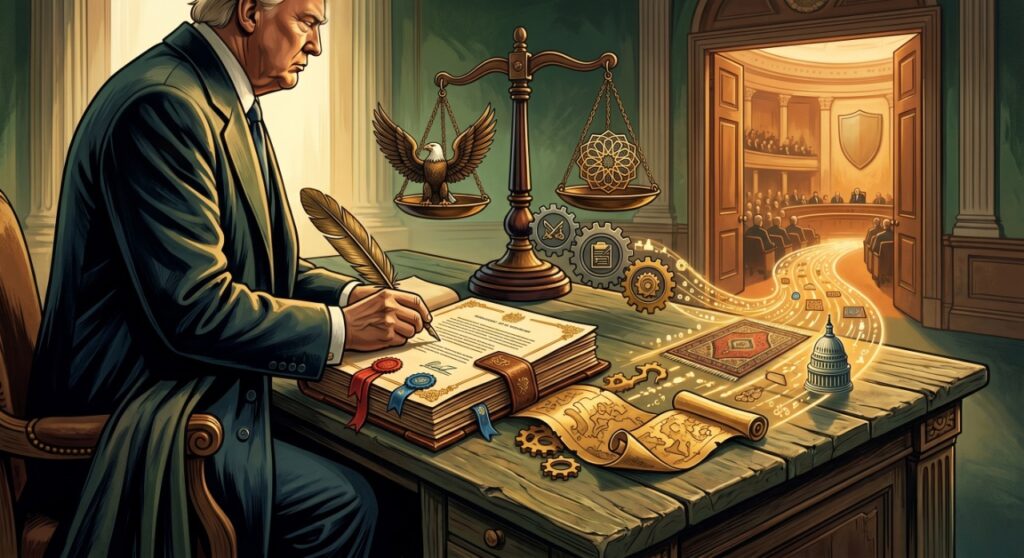
There is a particular kind of Washington fury that does not announce itself with a podium and a press release. It builds quietly, in the corner offices of Senate committee chairmen, in the terse one-liners of men who are ordinarily the president’s most reliable defenders. It is the fury of being kept in the dark. And on this particular Tuesday, June 16, 2026, as President Donald Trump schmoozes with world leaders at the G7 summit in the French Alpine resort town of Évian-les-Bains, that fury is running through the halls of Capitol Hill with rare and bipartisan intensity.
The subject of Washington’s anger is not the Iran deal itself — or rather, not only the deal itself. It is the fact that, three days after President Trump announced on Truth Social that the deal was “complete,” two days after he and Vice President JD Vance digitally signed the memorandum of understanding with Iran, and one day after Trump told reporters it was “all signed,” virtually no one in the United States Congress — including the leaders of his own party — has seen the text of the document.
Senate Majority Leader John Thune of South Dakota, one of the most powerful Republicans in Washington, told reporters on Tuesday that he had not been briefed on the agreement. “I certainly have not yet, although we are requesting that,” Thune said, “and I assume we at some point will hear from the administration with greater specificity about what’s in that memorandum.” Senate Minority Leader Chuck Schumer, speaking from the Senate floor, was more direct: “In these high-stakes negotiations, the devil is in the details, but Trump hasn’t even revealed the text of his, quote, ‘understanding,’ unquote, with Iran.” Senator Lindsey Graham of South Carolina — a national security hawk, an Iran hardliner, and one of Trump’s most prominent allies on Capitol Hill — said simply: “I want to see it myself.”
Into this simmering constitutional standoff, President Trump stepped on Tuesday afternoon with a remark that was, in equal parts, a serious constitutional signal and a piece of characteristic presidential theatre.
Arriving at a bilateral meeting on the sidelines of the G7 with United Arab Emirates President Mohammed bin Zayed Al Nahyan, Trump told reporters that he “wouldn’t mind” sending the memorandum of understanding to Congress for review. And then, apparently unable to resist the temptation to get the last word on an institution he has spent his political career treating with ambivalence, he added: “What I would like to do is send it to Congress and say, ‘You shouldn’t approve it.’ And they will approve it.”
The room, as it so often does in Trump’s vicinity, rippled with laughter. But beneath the joke was a statement of real constitutional and diplomatic significance — and one that raised as many questions as it answered.
Part One: The Deal That Nobody Has Read
To understand why Congress is so agitated, you have to understand what has and has not been disclosed about the memorandum of understanding since Trump first announced it on Sunday, June 14.
What is known, with confidence, is this: President Trump and Vice President Vance signed the MOU digitally on Monday. The agreement calls for the simultaneous lifting of Iran’s closure of the Strait of Hormuz and the removal of the United States naval blockade of Iranian ports. A formal signing ceremony is scheduled for this Friday in Geneva, Switzerland. Following the ceremony, the two sides will enter a 60-day negotiation period focused primarily on Iran’s nuclear program, sanctions relief, and the contours of any permanent peace arrangement.
What is not known — because the text has not been released — is almost everything else. The specific terms around uranium enrichment, around Iran’s ballistic missile program, around Iranian-backed proxy forces in Lebanon and elsewhere in the region, around the lifting of U.S. primary and secondary sanctions, around the exact nature and legal character of a reconstruction fund that may or may not be worth $300 billion depending on who you ask — all of this remains officially undisclosed.
That information vacuum has been filled, in the absence of official transparency, by leaks, social media posts, Iranian state media, and a cascade of competing characterizations that have made the political environment around the deal uniquely chaotic — even by the standards of Washington in 2026.
Iranian state-affiliated Mehr News Agency published what it described as a 14-point draft memorandum of understanding on Friday — before the deal was even officially announced — and the document, which has not been independently verified or officially confirmed by either side, has been circulating across social media platforms and conservative commentary circuits ever since. <cite index=”84-1″>According to Mehr’s reporting, the draft begins with an immediate and permanent end to military operations across all fronts, including Lebanon, alongside a U.S. commitment not to interfere in Iran’s internal affairs and to respect the sovereignty of the Islamic Republic.</cite> <cite index=”84-1″>The report says Washington would commit to lifting the naval blockade within 30 days, withdrawing forces from around Iran, and allowing the reopening of the Strait of Hormuz.</cite>
More explosively, <cite index=”84-1″>the reported framework includes a requirement for the United States and its allies to present reconstruction plans worth at least $300 billion for Iran.</cite> The Mehr report also indicated that <cite index=”84-1″>the two sides would enter a 60-day period of negotiations aimed at reaching a final agreement covering Iran’s nuclear program and the lifting of U.S. primary and secondary sanctions, as well as UN Security Council and IAEA-related restrictions.</cite>
Whether that document accurately reflects the actual MOU remains genuinely unclear. But the political damage it has done in Washington is very real.
Part Two: The $300 Billion Question — And the Presidential Contradiction
Of all the contested details swirling around the Iran deal on this Tuesday, none has generated more heat — or more contradictory statements from the administration itself — than the question of the $300 billion reconstruction fund.
The story broke into full public view on Monday, when Vice President Vance appeared on CBS News’ morning programming and made a remark that his own team has since been trying to walk back in increasingly complicated ways. <cite index=”63-1″>Vance confirmed that Iran could have access to a $300 billion reconstruction fund if it complied with the terms of the deal, noting “that’s the sort of thing they could have access to, funded by the Gulf Coast coalition, so long as they honor their end of the obligation.”</cite>
The statement landed like a grenade in Washington. Conservative commentators — many of whom had strongly supported the Iran War and are now watching the peace deal with deep suspicion — immediately drew comparisons to the most reviled element of the 2015 Obama-era JCPOA: the release of frozen Iranian assets, which critics on the right characterized at the time as directly funding Iranian terrorism. The Obama administration’s transfer of cash to Iran — including a notorious $1.7 billion payment delivered by airplane — has been a staple of Republican attack lines for the better part of a decade. The idea that a Trump deal might involve a sum orders of magnitude larger was, for those critics, a shock.
Trump’s response was swift and characteristically unequivocal. <cite index=”82-1″>In a Truth Social post, he dismissed reports about the $300 billion reconstruction fund, calling it “fake news” and writing: “Iran has agreed to never have a Nuclear Weapon! Also, the story that the U.S. is paying Iran 300 million dollars is Fake News, put out by the Dumocrats!!!”</cite>
There were two notable problems with this denial. The first is that the president appeared to conflate $300 billion with $300 million — a difference of three orders of magnitude. The second is that his own vice president had appeared to confirm, less than 24 hours earlier, that something like the fund existed — albeit framed as Gulf nation-funded and conditioned on Iranian compliance.
<cite index=”83-1″>Pressed on the possibility of unfreezing Iranian assets, Vance said while “we’re open to a lot of things that are on the table,” a specific $24 billion figure “just doesn’t appear anywhere in any of the texts that we’ve talked about with the Iranians.”</cite> That is a different denial from the president’s, and the distinction between them — between denying a specific dollar figure and denying the concept of a reconstruction fund altogether — is significant.
<cite index=”63-1″>Senior U.S. officials said the concept of a large reconstruction fund, along with frozen assets and sanctions relief, was among options expected to be discussed with Iran on Friday.</cite> That framing — “among options expected to be discussed” — is meaningfully different from either Trump’s “fake news” denial or Vance’s “they could have access to” confirmation. It suggests the $300 billion figure is not a confirmed term of the MOU but rather a concept on the table for the upcoming 60-day nuclear negotiations.
The result is a public communication environment that is, to put it charitably, deeply confusing. The administration is simultaneously denying and not denying the reconstruction fund, depending on which official is speaking and on which platform. And because the text of the MOU has not been released, there is no publicly available primary source that can adjudicate between the competing claims.
That is precisely what Congress is demanding be remedied.
Part Three: Capitol Hill Erupts — A Bipartisan Demand for Transparency
The congressional reaction to Trump’s Iran deal has been, from the very first hours after its announcement, unusually bipartisan in its demand for transparency — if not in its ultimate political judgment about the deal’s merits.
<cite index=”81-1″>Senate Democratic Leader Chuck Schumer called on the Trump administration to brief Congress immediately on the “understanding” with Iran. “The American people deserve details and full transparency — what exactly is in this ‘understanding’? Will servicemembers remain in harm’s way?” Schumer said in a statement.</cite> On the Senate floor on Monday, <cite index=”83-1″>Schumer pressed harder, noting that “it’s been nearly 24 hours since Trump announced there was a potential deal with Iran, and we still don’t know the details,” adding: “In these high-stakes negotiations, the devil is in the details, but Trump hasn’t even revealed the text of his quote, understanding, unquote with Iran. The American people need to know exactly what’s in the deal.”</cite>
That sentiment — stripped of its partisan framing — found an echo on the Republican side of the aisle in terms that were, for a party that has generally been reluctant to cross the president, striking in their directness.
<cite index=”74-1″>Senate Majority Leader Thune told reporters he didn’t “know enough about it to say” whether it was a good deal or not. Senator Roger Wicker of Mississippi offered only a terse “I’m withholding comment.”</cite> These are not the responses of legislators who are comfortable with how the administration has handled transparency around a deal of this magnitude.
Senator James Lankford of Oklahoma, a Republican, added a more substantive constitutional argument to the mix. <cite index=”62-1″>Lankford said on NBC News’ “Meet the Press” that “it is best” if Congress votes to ratify any potential deal to end the war in Iran, arguing that a deal approved by Congress would have a “more lasting effect.” He added that Trump is seeking to “end Iran’s constant attack of Americans and American assets and American allies in that region,” which he said has been going on for 47 years.</cite>
Lankford’s position reflects a broader constitutional argument that many legislators — on both sides of the aisle, and across the ideological spectrum from hawks to doves — believe fundamentally: that any significant executive agreement with a foreign adversary affecting national security, nuclear weapons policy, and international sanctions has the character of a treaty, and treaties require Senate ratification by a two-thirds supermajority under the U.S. Constitution.
<cite index=”76-1″>Graham posted to X on Sunday: “Under our law, any nuclear deal with Iran will be sent to Congress for review and a vote. I look forward to reviewing the final product.”</cite> He reiterated the point on Monday: <cite index=”76-1”>”I look forward to reviewing the actual document rather than relying on Iranian propaganda reports. The sooner it is released, the better.”</cite>
The Iran Nuclear Agreement Review Act of 2015 — passed by Congress during the Obama administration specifically in response to the JCPOA — does indeed require the executive branch to submit the text of any agreement with Iran relating to nuclear matters to Congress, after which a review period and potential vote occur. Whether the current MOU triggers that law is a legal question that, as of Tuesday, no administration official has answered definitively on the record.
Part Four: The Graham Problem — Trump’s Most Inconvenient Ally
Of all the Republican figures raising questions about the Iran deal, none is more politically significant — or more awkward for the White House — than Senator Lindsey Graham of South Carolina.
Graham has, over the course of his Senate career, established himself as perhaps the most prominent hawkish voice in the Republican Party on Iran specifically. He has supported military action against Iran, championed the maximum pressure sanctions campaign, and consistently argued that the Islamic Republic’s nuclear ambitions represent an existential threat not just to Israel and America’s Gulf allies but to the broader international order. He was among the most vocal supporters of the February 2026 military strikes. He has staked a significant part of his political identity on the idea that the United States must be resolute, uncompromising, and clear-eyed in its approach to Tehran.
Which is why his reaction to the MOU has been so politically explosive — and why Trump’s response to it has been so revealing.
<cite index=”71-1″>Graham voiced concern about discrepancies between different parties’ descriptions of the deal. “The MOU being described by us sounds really very good; the MOU being described by Iran sounds awful,” he told Politico.</cite> <cite index=”71-1″>The South Carolina Republican also fretted that the deal would resemble the Obama-era Joint Comprehensive Plan of Action. “If they can enrich [uranium] anywhere at all, then it’s the same as JCPOA.”</cite>
That last comment — “it’s the same as JCPOA” — is, in the vocabulary of Republican national security politics, about as damning a thing as can be said about a deal. The JCPOA was the totemic failure of the Obama foreign policy legacy, the agreement that Trump himself abandoned in 2018, the deal that — in the telling of virtually every Republican hawk — gave Iran a pathway to a nuclear weapon in exchange for sanctions relief and a flood of cash. To say that Trump’s deal might resemble it is to strike at the very heart of the president’s claim that he would do better.
Trump’s response to Graham’s skepticism was delivered at the G7 on Tuesday morning, in front of reporters, in his characteristic register of friendly menace: <cite index=”72-1″>”I’ll have to talk to Lindsey. He’ll be in big trouble,” the president said. “Lindsey’s good. Lindsey’s fine. He’s not skeptical,” he added.</cite>
The remark captures perfectly the peculiar political dynamic that has formed around the Iran deal on the right. Graham has not broken with Trump — he has, if anything, been careful to frame his skepticism in terms of process and transparency rather than in terms of outright opposition to the deal. <cite index=”70-1″>On X, Graham said he hopes Trump’s effort to “forever foreclose” Iran’s nuclear ambitions is successful. “The ultimate win for taking on Iran is to open up a pathway to peace through Abraham Accord expansion and build on regional integration,” he posted. “If the conflict with Iran yields this outcome, it will be one of the most successful military operations in American history.”</cite>
But the private concern is clearly deeper than the public statements indicate. Graham’s question — “if they can enrich anywhere at all, is it the same as JCPOA?” — goes to the absolute core of whether this deal represents a genuine constraint on Iran’s nuclear capabilities or merely a diplomatic pause in a longer confrontation.
Conservative media has been less restrained than Graham in voicing its criticism. <cite index=”74-1″>Washington Post columnist and American Enterprise Institute fellow Marc Thiessen wrote in response to one purported version of the MOU posted online: “If this is accurate it’s a complete disaster.”</cite> <cite index=”63-1”>Former Trump Secretary of State Mike Pompeo wrote on X: “I pray that any settlement preserves those sacrifices and secures the interests of the American people.”</cite> <cite index=”63-1”>Marc Thiessen also warned on Fox News that Trump’s emerging framework “looks a lot like Obama’s.”</cite>
Fox News host Mark Levin — one of the most influential voices in the conservative media ecosystem and a prominent backer of the Iran War — has been “repeatedly wonder[ing] aloud why the Trump administration won’t release the text.” That is a devastating line of criticism from someone who has been, until now, among the administration’s most reliable amplifiers.
The pattern is striking: the loudest voices demanding transparency are not Democrats. They are conservatives who supported the war, who trusted Trump’s instincts on Iran, and who now find themselves unable to evaluate whether the deal they are being asked to celebrate is actually what they were promised.
Part Five: The Constitutional Dimension — What Does Congress Actually Have the Power to Do?
The congressional fury over the Iran deal is not merely political theatre. It touches on fundamental questions of constitutional authority over war, treaties, and executive agreements that have been contested between the legislative and executive branches for decades — and which have never been more consequential than they are right now.
The key legal framework at issue is the Iran Nuclear Agreement Review Act of 2015, which was passed by a Republican Congress specifically to constrain the Obama administration’s ability to enter into nuclear agreements with Iran without legislative oversight. The law requires the executive branch to submit the text of any agreement with Iran relating to nuclear matters to Congress within five days of reaching such an agreement, after which Congress has a 30-day review period and the opportunity to pass a resolution of disapproval.
Whether the MOU currently on the table triggers this law is a question the administration has not directly addressed. The White House’s implicit position — reinforced by its delay in releasing the text and in briefing congressional leaders — appears to be that the MOU is a preliminary framework document, not a final nuclear agreement, and that the formal nuclear deal — when and if it is negotiated over the 60-day period — would be the document subject to congressional review.
That is a legally plausible position, but it is not one that has been stated explicitly, and it leaves a significant amount of constitutional ambiguity around the current moment. If the MOU contains substantive commitments on nuclear matters — as the Iranian state media version of the document suggests it does, including a reiteration of Iran’s NPT commitments and provisions governing enrichment — then the argument that it falls outside the 2015 Review Act becomes harder to sustain.
Senator Lankford’s view — that congressional ratification is “best” for durability — reflects a broader institutional logic that transcends the current political moment. Executive agreements can be reversed by the next president. Trump himself reversed the JCPOA, which was structured as an executive agreement rather than a Senate-ratified treaty. A deal that passes through Congress — that receives the endorsement of at least a majority in both chambers, or ideally the two-thirds supermajority required for treaty ratification — has a legal and political durability that an executive agreement alone cannot achieve.
That logic has been reinforced, with painful irony, by Trump’s own history. He withdrew from the JCPOA in 2018 precisely because it had not been ratified by Congress and therefore had no binding legal force. To now argue that his own Iran deal should bypass Congress is to adopt exactly the logic that Obama used in 2015 — the same logic that Trump and his allies spent years excoriating.
Part Six: What Trump Actually Said — Parsing the G7 Remarks
Trump’s comments at the G7 on Tuesday about sending the MOU to Congress deserve careful parsing, because they are, in their characteristic way, simultaneously serious and self-undermining.
<cite index=”64-1″>Arriving at a bilateral meeting with UAE President Mohammed bin Zayed Al Nahyan, Trump said he wouldn’t mind sending the memorandum of understanding to Congress for review. He did not indicate when Congress might receive the details.</cite>
The key phrase is “he wouldn’t mind” — which is not the same as “he will” or “he intends to.” It is a signal of openness, not a commitment. It is the kind of statement that can be walked back without technically constituting a reversal, and that can be pointed to later as evidence of good faith if the administration ultimately does share the document.
The joke that followed — <cite index=”64-1″>”What I would like to do is send it to Congress and say ‘you shouldn’t approve it.’ And they will approve it”</cite> — is revealing in a different way. It reflects Trump’s confidence that, once the political pressure has been relieved by the act of disclosure itself, congressional Republicans will fall into line. He has been through this before. He knows that his party’s members will raise objections in the period of uncertainty, and that those objections will soften once the text is in their hands and they have been briefed directly by the administration.
The president’s broader comments at the G7 on Tuesday gave slightly more shape to the deal. <cite index=”70-1″>Trump said that second-stage talks over Iran’s nuclear program will unfold rapidly after the preliminary deal is inked on Friday, and that “all hell will rain down” if Tehran violates its commitments.</cite> He also addressed one of the central anxieties of congressional skeptics — the question of whether Iran would receive U.S. funding — by insisting that the United States “is not investing any money.” In his own words at the G7: “We’re not investing any money. We have the right to if we want, but we’re not investing any money. We didn’t pay for it like Obama did. He paid billions of dollars, he paid $1.7 billion from an airplane, all green cash. I watched that, I couldn’t believe it.”
The implicit argument is clear: this deal is fundamentally different from Obama’s, because Obama paid Iran and Trump is not. Whether that characterization holds up to scrutiny — given the complexity of what constitutes “payment” when frozen assets are unfrozen and sanctions are lifted — will be one of the central points of congressional debate once the text is actually released.
Part Seven: The Iran Side of the Story — A Different MOU
One of the most politically corrosive features of the current situation is the stark divergence between how the U.S. administration and Iranian officials are characterizing the MOU’s terms — a divergence that Graham himself identified and that has fueled conservative anxiety about the deal.
<cite index=”71-1″>Graham told Politico: “The MOU being described by us sounds really very good; the MOU being described by Iran sounds awful.”</cite> That formulation — that the two parties are reading the same document in radically incompatible ways — is not merely a political concern. It is a warning that the gap between the two sides’ interpretations could produce a catastrophic breakdown once the 60-day nuclear negotiations begin.
The Iranian state media version of the deal — through Mehr News Agency’s 14-point draft — paints a picture of significant U.S. concessions: a commitment to respect Iranian sovereignty, the lifting of sanctions, a reconstruction fund of at least $300 billion, and a withdrawal of U.S. forces from the region. The Trump administration’s public characterization — articulated by Vance across multiple media appearances — emphasizes Iran’s commitment to never acquiring nuclear weapons, the opening of the Strait of Hormuz, and a comprehensive change in Iranian behavior toward regional peace and cessation of terrorism support.
<cite index=”83-1″>Vance said that preventing Iran from developing a nuclear weapon or reconstituting its nuclear program are the most important issues, but that U.S. officials “certainly expect that as part of our broader agreement… Iran is going to stop funding terrorist organizations.” He pointed to a portion of the memorandum that said Iran must commit to “regional peace and stability.”</cite>
<cite index=”63-1″>The Vance framing described three key provisions of the MOU during his Monday media appearances: first, the Strait of Hormuz will remain open immediately; second, Iran will never have a nuclear weapon; and third, if Iran changes its behavior and stops funding terrorism, the U.S. would open economic opportunities.</cite>
These two framings are not necessarily incompatible — a deal can involve U.S. economic openings and Iranian behavioral commitments simultaneously — but the divergence in emphasis and specificity between the two sides’ public statements strongly suggests that the MOU contains deliberate ambiguities that will be exploited by both sides in the 60-day negotiations to come. That is how many preliminary diplomatic agreements work: they are intentionally general, allowing each party to present them to its domestic audience in the most favorable light, while deferring the hard specifics to future talks.
The danger — and the reason congressional hawks are so alarmed — is that Iran’s interpretation of the MOU as a document requiring a $300 billion reconstruction fund, the lifting of U.S. sanctions on oil sales and international banking, and the withdrawal of U.S. forces from the region is politically untenable in Washington. If those are indeed the terms Iran believes it has agreed to, and if the 60-day negotiations fail to bridge the gap between Iranian expectations and what Congress will accept, the ceasefire could unravel before a final agreement is reached.
Part Eight: The Lebanon Complication — One More Unresolved War
Any accounting of the Iran deal’s vulnerabilities must include what has become one of its most intractable complications: Israel’s military presence in Lebanon and the ongoing conflict with Hezbollah.
<cite index=”81-1″>One major issue left unaddressed in the MOU is the occupation of territory in Lebanon by Israeli forces. Israeli Defense Minister Israel Katz said Monday that Israeli troops would remain in south Lebanon, and Israeli Prime Minister Benjamin Netanyahu has not yet commented on the deal.</cite>
This is not a minor loose end. Iran made ending the fighting in Lebanon a condition for any comprehensive agreement with the United States, and the Iranian-backed Hezbollah remains an active participant in a conflict that has not been formally included in the ceasefire framework. If Israel maintains its position in southern Lebanon — which Defense Minister Katz’s statement suggests it intends to do — Tehran could claim that the United States has not delivered on what Iran understood to be a precondition of the deal, providing a pretext for Iran to withdraw from the MOU before the formal signing in Geneva on Friday.
Trump himself complicated matters by, in the words of CNN’s coverage, “breaking sharply” with Israeli Prime Minister Benjamin Netanyahu over the Lebanon situation — a remarkable development given the closeness of the Trump-Netanyahu relationship and one that has sent a ripple of concern through the pro-Israel constituency that has been a core part of Trump’s political coalition.
<cite index=”63-1″>Mark Levin, a Fox News host who has been an influential backer of the war, seemed to take exception after Trump decried Israel for targeting Hezbollah in Lebanon amid peace negotiations.</cite> When Mark Levin publicly distances himself from Trump on Israel, the political dynamics within the Republican base are shifting in ways that the White House clearly did not anticipate.
Conclusion: A Deal Nobody Has Read, in a World That Cannot Afford It to Fail
As Tuesday draws to a close, the Iran deal finds itself in a peculiar diplomatic limbo — announced but unread, celebrated but contested, signed but not yet formally concluded. The text of the memorandum of understanding remains officially unreleased. The Senate Majority Leader has not been briefed. The Senate Minority Leader is demanding transparency from the Senate floor. The president’s closest ally on Iran policy in the Senate is publicly wondering whether the deal might be worse than the JCPOA. Conservative media commentators who supported the war are calling the reported deal “a complete disaster.” And the president himself is at a G7 summit in France, trading jokes about congressional approval and warning that “all hell will rain down” if Iran violates its commitments.
Trump’s signal that he could send the MOU to Congress is, in this context, more than a procedural concession. It is an acknowledgment — however reluctant, however characteristically wrapped in performance — that the deal cannot succeed politically without congressional buy-in. A peace agreement with Iran that is opposed by the Senate Majority Leader, the chairman of the Senate Armed Services Committee, and the most prominent Republican foreign policy hawk in America is not a peace agreement. It is a political liability.
The challenge for the administration in the days ahead is to release enough of the text to satisfy the legitimate demand for transparency, without releasing language that confirms the worst fears of critics on the right about reconstruction funds, enrichment permissions, and the deal’s resemblance to the JCPOA. It is a communications challenge of significant complexity, made harder by the fact that the Iranians have already put their own version of the deal into the public domain — and that their version is, in at least some respects, considerably more favorable to Iran than what the Trump administration has publicly described.
The formal signing ceremony in Geneva is scheduled for Friday. Seventy-two hours stand between the world and whatever measure of clarity that ceremony will or will not provide.
For the members of the United States Congress who have not yet seen the document they are being asked to endorse — that is seventy-two hours of waiting in the dark, in Washington’s most uncomfortable tradition.
This journal narrative has been compiled from reporting by CNBC, The Hill, The New Republic, The Washington Times, CBS News, NBC News, Newsweek, CNN, Iran International, and other sources as of Tuesday, June 16, 2026. All reporting reflects the state of public knowledge as of the date of publication. It is intended as journalistic analysis and does not constitute legal, financial, or policy advice.