
The Engine and the Passenger: Mark Cuban, the 401(k), and the Uncomfortable Symbiosis Between Ordinary Savers and Extraordinary Fortunes

Preface: A Provocation on X
On Saturday, June 13, 2026, billionaire entrepreneur Mark Cuban — co-founder of broadcast.com, longtime owner of the Dallas Mavericks, fixture of “Shark Tank,” and one of America’s most relentlessly online business figures — posted a message on X that would, within days, ripple across financial media, provoke fierce debate among economists and ordinary investors alike, and reopen one of the most persistent and unresolved arguments in American economic life: who, exactly, is responsible for the staggering and ever-growing fortunes of the nation’s billionaire class — and who, in turn, benefits from them?
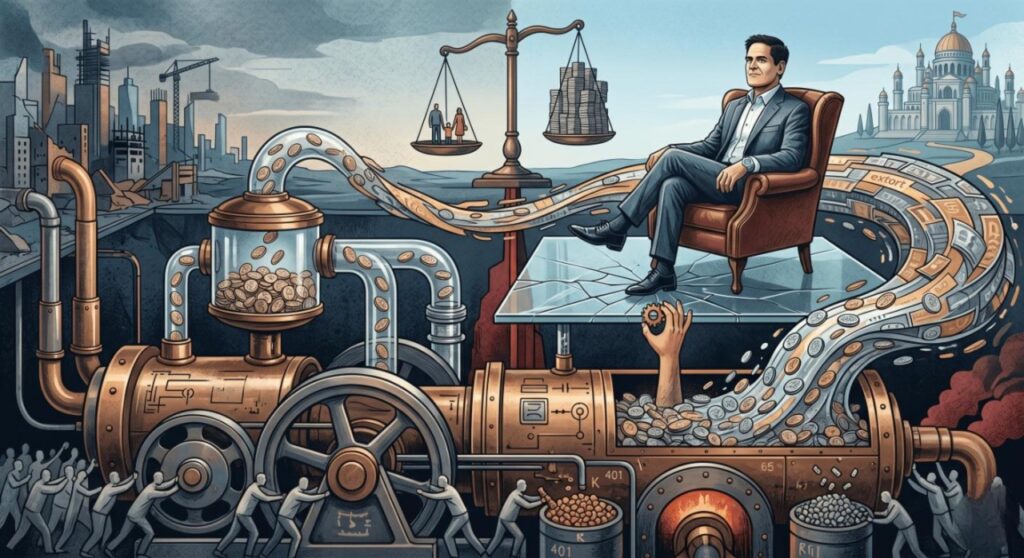
Cuban’s argument, distilled to its essence, was this: the very same retirement accounts that tens of millions of ordinary American workers rely upon for their financial future — the unglamorous, payroll-deducted, employer-matched 401(k) plans that quietly accumulate in the background of working life — are not separate from the wealth of figures like Elon Musk. They are, in Cuban’s telling, the engine of it. And in being the engine of billionaire wealth, Cuban argued, they are simultaneously a vehicle for the financial security of the very people who might otherwise resent that wealth.
It is a claim that flatters no political tribe entirely, unsettles assumptions on both the left and the right, and forces a confrontation with an uncomfortable structural reality of modern American capitalism: that the fortunes of the ultra-rich and the retirement security of the middle class are not opposing forces in a zero-sum contest, but are, in a very literal financial sense, the same phenomenon viewed from two different vantage points.
This journal essay undertakes a comprehensive examination of Cuban’s claim — its origins, its mechanics, the empirical evidence for and against it, and its implications for how American society thinks about wealth inequality in an era when the gap between the ultra-wealthy and the median household has reached historic extremes, even as the median household’s own portfolio has quietly become more valuable than at any point in history.
Part I: The Spark — What Cuban Actually Said
The immediate trigger for Cuban’s comments was, as is so often the case in the attention economy of 2026, a piece of sarcastic commentary from another user on X. <cite index=”36-1″>Cuban took to X to respond to criticism from another poster, who sarcastically wrote that “Capitalism is better than socialism because one man gets to be a trillionaire instead of everyone having healthcare.”</cite>
The jab was a familiar one in the genre of internet political commentary — a pointed, almost rhetorical question dressed as an observation, designed to highlight what its author saw as an absurd trade-off at the heart of American capitalism: that the system permits, even celebrates, the accumulation of a trillion dollars by a single individual while tens of millions of Americans struggle with the cost of medical care.
Cuban’s response did not dismiss the underlying frustration about healthcare costs. But it did directly challenge the framing of the first half of the sentence — the implicit suggestion that a trillionaire’s wealth exists in some kind of moral or economic competition with the wellbeing of everyone else.
<cite index=”36-1″>”The reason anyone gets insanely rich is almost always because of the stock market,” Cuban wrote.</cite> He went on to argue that <cite index=”36-1″>capitalism’s defining strength lies in the fact that roughly 150 million Americans can, through their own investment decisions, influence exactly what happens in the country’s economy.</cite>
The specific reference point for the exchange was unmistakable. <cite index=”44-1″>Cuban’s comments came in the same week that Elon Musk made history, reportedly becoming the world’s first trillionaire, fueled largely by SpaceX’s blockbuster Nasdaq debut.</cite> <cite index=”44-1″>SpaceX priced its IPO at $135 per share, opened at $150, and soared as much as 30% on its debut, instantly minting Musk’s trillionaire status.</cite> <cite index=”45-1″>The rocket and satellite company raised a record $75 billion in its offering, valuing the company at about $1.8 trillion and pushing the value of Musk’s stake in SpaceX to an estimated $690 billion. Combined with his holdings in Tesla and other investments, Musk’s net worth was estimated at approximately $1.1 trillion.</cite>
It was, in other words, the most vivid and immediate illustration imaginable of the phenomenon Cuban was describing: a single individual crossing a wealth threshold that had never before been reached by a human being, in the same week that ordinary Americans were going about their ordinary financial lives — checking their 401(k) balances, making their biweekly contributions, watching their retirement accounts tick upward by fractions of a percent.
Part II: The Mechanics of the Argument — How a 401(k) Actually Builds a Billionaire’s Fortune
To understand whether Cuban’s argument holds analytical water — as opposed to simply being a clever rhetorical parry — it is necessary to walk through the actual financial mechanics he was describing, because they are more concrete and more verifiable than they might initially appear.
<cite index=”34-1″>Cuban’s central point is straightforward: billionaire wealth is often tied to company ownership that’s upheld by the average investor.</cite> The reason people like Elon Musk become extraordinarily rich, in this telling, <cite index=”34-1″>isn’t simply because they founded successful companies. It’s because millions of Americans voluntarily buy and hold shares of those companies through brokerage accounts, mutual funds, pensions and retirement plans.</cite>
This is not merely a rhetorical flourish; it describes an actual and quantifiable financial mechanism. When an entrepreneur founds a company and retains a large ownership stake — as Musk has done with both Tesla and SpaceX — the dollar value of that stake is not determined by the entrepreneur. It is determined by what other people are willing to pay for shares of the company, whether directly (buying individual stock) or indirectly (through index funds, mutual funds, pension funds, and retirement accounts that hold the stock as part of a diversified portfolio).
When a 401(k) plan participant contributes a portion of their paycheck to a target-date fund, an S&P 500 index fund, or a similar diversified vehicle, that money flows — often without the participant’s specific knowledge or intent — into shares of companies like Tesla, Apple, Nvidia, Amazon, and dozens of others whose founders or major shareholders are among the world’s wealthiest individuals. The demand created by tens of millions of such contributions, repeated every pay period, across decades, is a structural force that bids up valuations across the entire market — including the shares held by founders and early investors.
Musk himself, in comments made earlier in 2026, offered a strikingly similar account of his own wealth’s composition. <cite index=”47-1″>”My ‘net worth’ is almost entirely due to my ownership stakes in Tesla and SpaceX. I have less than 0.1% that is cash,” Musk wrote in February 2026, responding to a related debate about wealth creation. He added that Tesla and SpaceX employees all receive stock and options, and noted that Tesla is “more than 80% owned by retail investors and index/pension funds.”</cite>
That detail — Tesla’s ownership structure being overwhelmingly composed of retail investors and pension and index funds, rather than institutional insiders or sovereign wealth funds — is central to understanding why Cuban’s framing has genuine analytical force. <cite index=”37-1″>”You know who is funding the increase, particularly lately? Retail investors. 401ks,” Cuban wrote in an earlier related post.</cite> The valuation of Tesla, and by extension a substantial portion of Musk’s net worth, is not maintained by a small circle of ultra-wealthy financiers trading among themselves. It is maintained, in significant part, by the aggregate purchasing decisions of ordinary American workers’ retirement accounts.
<cite index=”36-1″>Cuban argued that anyone seeking to eliminate billionaire wealth would first have to convince millions of Americans to sell their stocks, mutual funds, and retirement holdings. Such a move, he said, would wipe out the net worth of most of those very people in the process.</cite>
This is, in effect, an argument about the structural entanglement of wealth in a financialized economy: that the assets which constitute Musk’s trillion-dollar fortune are the same assets — Tesla stock, broad index funds, the general appreciation of the U.S. equity market — that constitute the retirement security of tens of millions of middle-class Americans. The valuations are shared. The fortunes, in a mathematical if not a moral sense, rise and fall together.
Part III: The Healthcare Counter-Argument — Where Cuban Draws a Line
It would be a mischaracterization of Cuban’s position to suggest that he dismissed the healthcare critique embedded in the original sarcastic post. In fact, Cuban’s response carved out a deliberate distinction between two different critiques of American capitalism that are often, in popular discourse, conflated into one.
<cite index=”34-1″>Cuban addressed the original poster’s healthcare jab directly, saying that billionaire wealth isn’t so much the problem, and that “behemoth healthcare conglomerates” are the bigger issue at hand.</cite>
This distinction matters because it reveals something important about the structure of Cuban’s worldview, which does not fit neatly into either a conventional pro-billionaire or anti-billionaire framework. <cite index=”34-1″>For years, Cuban has criticized opaque pricing systems, pharmacy benefit managers, and large healthcare intermediaries that he believes drive up costs for employers and consumers.</cite> <cite index=”34-1″>Through ventures such as his Cost Plus pharmacy business and newer direct-contracting healthcare initiatives, Cuban has pushed for more transparent pricing and direct relationships between employers and healthcare providers.</cite>
In other words, Cuban’s position is not “billionaire wealth is good and healthcare costs are not a problem.” It is something more specific and more analytically precise: that the existence of extraordinary individual wealth and the dysfunction of the American healthcare pricing system are two largely separate phenomena, with different causes, different mechanisms, and different potential remedies. Conflating them — treating Musk’s trillion dollars as the reason a worker cannot afford insulin — obscures the actual causal chain behind healthcare costs, which runs through pharmacy benefit managers, hospital pricing opacity, insurance market structures, and drug patent law far more directly than it runs through stock market valuations.
<cite index=”34-1″>Whether Cuban’s vision for healthcare transparency can be scaled nationwide remains an open question. Healthcare economists point to a complex web of insurers, providers, drug manufacturers, and regulators that all influence costs.</cite> This is, in effect, Cuban’s argument: that the energy directed at billionaire wealth as the symbol of capitalism’s failures might be better redirected toward the specific industries and pricing structures that actually determine whether an American family can afford to see a doctor.
Part IV: The Data — How Many Americans Actually Hold Stock, and How Much
Cuban’s specific figure — 150 million Americans — deserves scrutiny, because the precision of such claims matters for evaluating whether the underlying argument holds up under examination.
<cite index=”56-1″>According to a recent Gallup survey, 58% of U.S. adults invest in stocks, which translates to roughly 156 million Americans. That figure is down 4 percentage points from 2025 but represents a 6-point increase from 2016.</cite> <cite index=”56-1″>Stock ownership had fallen as low as 52% in 2013 and 2016 following the 2008 financial crisis, before recovering in subsequent years.</cite>
<cite index=”56-1″>According to Federal Reserve data, 58% of U.S. families — about 72 million families — held stock as of 2022, with 21% of families, or roughly 26 million, holding stock directly rather than through funds or retirement accounts. Most Americans, however, hold stock indirectly, through a mutual fund, an index fund, or a retirement account such as a 401(k).</cite>
This last point is critical to Cuban’s argument: the overwhelming majority of American stock exposure is not the product of individuals actively picking stocks like Tesla or studying SpaceX’s prospectus. It is the passive, often unconscious byproduct of enrollment in a workplace retirement plan — frequently an automatic enrollment that the worker did not actively choose. <cite index=”55-1″>Workers with automatic enrollment in a 401(k) save at rates above 85%, while workers who must open an IRA on their own see participation rates drop below 15% in the same income brackets.</cite> <cite index=”55-1″>401(k) plans hold the majority of American retirement wealth outside of Social Security.</cite>
The aggregate scale of this exposure has reached historic highs. <cite index=”52-1″>Americans held a record share of their wealth in stocks at the end of 2025, with household exposure to equities reaching historic levels in recent years.</cite> This is, in a very real sense, the foundation of Cuban’s claim: never before in American history has the retirement security of so many ordinary households been so directly and so heavily tied to the performance of the stock market — the same stock market whose valuations produce figures like Musk’s trillion-dollar fortune.
The 401(k) data for 2026 paints a picture of an account type that has become, for a meaningful slice of the population, a genuine pathway to significant wealth, even as the broader population’s experience remains far more modest. <cite index=”53-1″>Empower Personal Dashboard data shows that more than one in five people, 21.9%, fall into the category of “401(k) millionaire” as of March 31, 2026, having accumulated at least $1 million in retirement savings in employer-sponsored plans and individually controlled IRA accounts. There were 1,035,757 401(k) accounts with balances of at least $1 million as of that date, with an average balance for this group of $1,249,484.</cite>
<cite index=”53-1″>Average 401(k) balances overall reached $343,739 as of March 31, 2026, up 8.9% year over year.</cite> But this average figure, as is so often the case with wealth statistics, obscures a much more unequal underlying distribution. <cite index=”55-1″>The median is the more honest number: it tells you where the middle American actually stands. The median American aged 55 to 64 — the cohort closest to retirement — has $185,000 in retirement savings. The median for all working-age Americans with any savings at all is $87,000. And roughly 28% of Americans have nothing saved for retirement at all.</cite>
That final statistic — more than a quarter of working-age Americans with zero retirement savings — is, in some ways, the most important data point for evaluating Cuban’s argument, because it identifies the population for whom his framing provides no comfort whatsoever. For the 28% with no retirement account, the relationship between billionaire wealth and personal financial security that Cuban describes simply does not apply. They are neither beneficiaries of the stock market’s gains nor, in any meaningful financial sense, participants in the system Cuban is describing. For them, the trillion-dollar fortunes accumulating in the same economy can only ever look like distant abstractions — or, more pointedly, like evidence of a system that has generated extraordinary gains for some while leaving others entirely outside its benefits.
Part V: The Counter-Arguments — Where Cuban’s Framing Faces Resistance
No argument of this kind survives public scrutiny unchallenged, and Cuban’s framing has drawn substantive pushback from multiple directions, each worth examining on its own terms.
The distributional critique. The most immediate and intuitive objection to Cuban’s argument is that it describes an aggregate phenomenon while obscuring a deeply unequal distribution. Yes, 150 million or more Americans hold stock in some form. But the value of those holdings is wildly uneven. A household with $5,000 in a 401(k) and a household with $5 million in a 401(k) are both, technically, “benefiting” from the same market dynamics that produce billionaire wealth — but the scale of that benefit, and its significance to each household’s actual financial security, could not be more different. <cite index=”54-1″>As of January 1, 2026, the collective net worth of America’s top 12 billionaires alone surpassed $2.7 trillion — a figure that has more than quadrupled since March 2020, when it stood at $608 billion.</cite> The growth rate of wealth at the very top of the distribution has, by most empirical measures, dramatically outpaced the growth rate of the median retirement account, even in years when both have technically risen together.
The causality critique. A more sophisticated objection challenges the direction of causality embedded in Cuban’s argument. Cuban frames retail and retirement investment as the cause of billionaire wealth — the demand that “funds the increase.” But critics counter that this inverts the actual causal sequence: it is the perceived quality, growth potential, and scarcity of ownership in companies like Tesla and SpaceX that draws retail and institutional investment in the first place, not the other way around. In this reading, the 401(k) money is less an active “engine” of billionaire wealth and more a passive beneficiary of decisions and innovations the entrepreneur already made — buying into a value-creation process that was substantially set in motion before most retail investors ever purchased a share.
The systemic risk critique. A third line of criticism focuses on the fragility embedded in the very interdependency Cuban describes. If tens of millions of American retirement accounts are now substantially tied to the valuations of a relatively small number of mega-cap companies and their founders’ fortunes, that is not necessarily a reassuring fact — it may instead represent a significant concentration of systemic risk. <cite index=”43-1″>Tesla’s own stock performance in 2026 offers a cautionary illustration: even as Musk’s combined SpaceX and Tesla stakes pushed his net worth past $1 trillion, Tesla shares themselves were down 11% for the year, trailing the broader S&P 500 by roughly 19 percentage points.</cite> A retirement account holding Tesla stock through an index fund in early 2026 would have experienced that decline directly — a reminder that the “shared fortune” Cuban describes moves in both directions, and that ordinary investors absorb downside volatility in mega-cap stocks just as they participate in the upside.
The political-economy critique. Perhaps the deepest critique of Cuban’s framing comes from those who argue that it functions, whether intentionally or not, as a justification for an economic structure that many economists and policymakers consider increasingly dysfunctional. The argument that “your 401(k) is why billionaires get rich, and that’s good for you too” can be read as a sophisticated restatement of trickle-down economic logic — an argument that ordinary people should not resent extreme wealth concentration because they are, in some diffuse and largely passive sense, beneficiaries of the same system that produces it. Critics on the political left have argued that this framing distracts from more direct policy interventions — wealth taxes, profit-sharing mandates, stronger labor bargaining power — that could more directly and more equitably distribute the gains of corporate value creation, rather than relying on the indirect and unevenly distributed mechanism of stock market exposure.
Part VI: Cuban’s Own Proposed Remedy — Employee Ownership
It is worth noting that Cuban’s commentary on this topic, viewed across multiple recent statements, does not stop at simply observing that billionaire wealth and retirement wealth are entangled. He has also, separately, argued for structural reforms that would more directly distribute corporate ownership to workers — a position that complicates any reading of his views as simple billionaire-class apologetics.
<cite index=”37-1″>”The better question is, why are we not giving incentives to companies to require them to give shares in their companies to all employees, at the same percentage of cash earnings as the CEO?” Cuban wrote in an earlier post on the topic.</cite>
This is a meaningfully more redistributive position than the “your 401(k) already benefits you” argument might suggest in isolation. <cite index=”37-1″>While many companies already offer stock ownership or profit-sharing plans, many cap what employees can receive. Intel, for instance, has an enrollment period twice a year in which employees can buy stock up to 15% of their salary at a 15% discount, capped at a maximum of $21,250 a year. Adobe offers a similar structure, allowing employees to contribute up to 25% of their salary, also capped at $21,250 annually, at a 15% discount.</cite>
Cuban’s argument here moves beyond the passive, indirect form of wealth-sharing embodied by 401(k) index fund exposure and toward a more direct proposal: that companies should be incentivized, or perhaps required, to allocate equity to ordinary employees in proportion to their cash compensation, mirroring the equity-heavy compensation structures that have made many corporate executives extraordinarily wealthy even when their cash salaries are comparatively modest.
This dimension of Cuban’s thinking complicates the simple narrative that emerged from his viral June 13 post. He is not merely defending the status quo distribution of wealth by pointing to indirect retirement account exposure; he has also articulated, on other occasions, a more active critique of how narrowly equity compensation is currently distributed, and a policy preference for broadening it.
Part VII: The Broader Context — Wealth Concentration in 2026
To fully evaluate Cuban’s claim, it is necessary to situate it within the broader trajectory of American wealth concentration as it stands in the middle of 2026 — a trajectory that provides ammunition for both Cuban’s defenders and his critics.
The trillionaire milestone reached by Musk this month is not an isolated anomaly but the latest data point in a long-running trend of accelerating wealth concentration at the very top of American society. <cite index=”51-1″>As recently as September 2024, Musk’s net worth — while already the largest in the world — stood at approximately $251 billion, with analysts projecting that his wealth, growing at a rate of roughly 110% annually, could make him history’s first trillionaire within roughly three years.</cite> That prediction has now been borne out, and arguably accelerated, by the SpaceX IPO.
<cite index=”48-1″>As recently as February 2026, Musk’s fortune stood at an estimated $849.3 billion, putting him atop the Forbes real-time billionaires list, ahead of Larry Page at $251 billion, Sergey Brin at $231.7 billion, and Mark Zuckerberg at $219.4 billion — all U.S.-based technology leaders.</cite> The concentration of the very largest American fortunes within a small cluster of technology entrepreneurs, rather than spread across more diverse sectors of the economy, is itself a notable structural feature of contemporary wealth inequality — one that Cuban’s framing, focused on broad stock market participation, does not fully address, since the specific companies generating the largest fortunes are disproportionately concentrated in technology, a sector where workforce participation (and therefore the “shared upside” Cuban describes) is itself unevenly distributed across the broader labor force.
Prediction markets have, in the months leading up to Musk’s trillionaire milestone, treated the question of his wealth trajectory as a matter of active financial speculation in its own right. <cite index=”49-1″>Kalshi traders, as of earlier this year, had assigned a 53% probability to Musk becoming a trillionaire by 2029, with the probability of reaching that threshold before 2028 standing at 48%.</cite> The fact that Musk crossed the trillion-dollar threshold considerably faster than even these relatively bullish prediction markets anticipated — driven by the unexpected scale of the SpaceX IPO — illustrates the genuine unpredictability and velocity of wealth accumulation at the very top of the economic pyramid in 2026, a velocity that stands in stark contrast to the comparatively glacial pace at which median retirement savings accumulate.
Part VIII: The View From the Middle — What This Debate Means for the Median American Worker
For the median American household, neither fully persuaded by Cuban’s optimistic framing nor entirely cynical about the stock market’s role in their financial life, the practical reality sits somewhere between the two poles of this debate.
The data is unambiguous on one point: participation in employer-sponsored retirement plans, where available, produces measurably better financial outcomes than the alternative. <cite index=”55-1″>Workers with automatic enrollment in a 401(k) save at rates above 85%, compared to participation rates below 15% among workers who must independently open an IRA in the same income brackets.</cite> This is not a marginal difference; it is close to a sixfold gap in participation, driven almost entirely by the behavioral economics of default enrollment rather than by any difference in workers’ underlying financial sophistication or commitment to saving.
The growth in 401(k) millionaires, while concentrated among a relatively small slice of the working population, nonetheless reflects a genuine and replicable financial outcome available to ordinary workers who maintain consistent contributions over long periods. <cite index=”58-1″>Fidelity data from recent years has consistently shown that the profile of a typical “401(k) millionaire” is not someone who made extraordinary individual stock picks, but someone who maintained a high savings rate within the same employer plan over an average tenure of roughly 26 years. “These are the poster children of staying the course and taking a long-term approach,” as one Fidelity executive described the cohort.</cite>
At the same time, the structural reality that nearly 28% of working-age Americans have no retirement savings whatsoever represents a genuine and largely unaddressed gap in Cuban’s framing. For this population — disproportionately composed of lower-income workers, those employed by small businesses without retirement benefits, gig economy workers, and others outside the formal employer-sponsored benefits system — the relationship between billionaire wealth and personal financial security that Cuban describes is, in practical terms, theoretical rather than lived. They are exposed to the costs of a financialized economy — rising asset prices that make homeownership and other forms of wealth-building more difficult to access — without sharing meaningfully in its gains.
This bifurcation, between Americans substantially integrated into the stock market’s wealth-building mechanisms and those entirely excluded from them, may ultimately be the most important and least discussed dimension of the entire debate that Cuban’s June 13 post reignited. The question is not simply whether 401(k)s “build” billionaire wealth, or whether billionaire wealth “builds” ordinary Americans’ retirement security — both propositions contain genuine truth, operating simultaneously, for the roughly 70% of Americans with meaningful retirement account exposure. The more urgent question is what happens to the remaining 28-30% of the population for whom neither half of that exchange currently applies — and whether policy interventions, ranging from universal automatic retirement enrollment to more direct profit-sharing mandates of the kind Cuban himself has proposed, might eventually close that gap.
Conclusion: An Argument That Resists Easy Resolution
Mark Cuban’s June 13 post on X was, on its surface, a brief and somewhat combative reply to an internet stranger’s sarcastic jab about capitalism and healthcare. But the argument it contained — that the wealth of figures like Elon Musk is mechanically and inextricably bound up with the retirement savings of ordinary Americans, rather than existing in moral or economic opposition to them — touches one of the genuinely unresolved structural questions of American economic life in 2026.
The empirical foundation of Cuban’s claim is, in significant part, sound. The valuations that produce trillion-dollar fortunes are substantially supported by the aggregate purchasing power of retail investors and retirement account holders, exactly as Cuban describes. Musk’s own characterization of his ownership structure — Tesla majority-owned by retail investors and pension and index funds — corroborates the basic mechanics of Cuban’s argument.
But the argument’s persuasive force diminishes considerably once the aggregate statistics are disaggregated. The benefits Cuban describes are real for the roughly 58% of American adults who hold stock, and meaningfully significant for the smaller subset who have accumulated substantial retirement balances over long careers. They are essentially theoretical for the 28% of working-age Americans with no retirement savings at all — a population for whom billionaire wealth accumulation looks far more like extraction than shared prosperity, regardless of the mechanics by which that wealth is technically generated.
What remains, after the debate subsides and the news cycle moves on, is a genuinely difficult policy question that transcends Cuban’s particular framing: how should a society structure its economic institutions so that the undeniable wealth-generating power of public equity markets is shared more broadly and more equitably — not merely through the passive, unevenly distributed mechanism of 401(k) exposure, but through more deliberate structures of the kind Cuban himself has separately proposed, including broader and more proportionate employee equity participation? On that question, billionaire entrepreneurs, retirement-savings researchers, labor economists, and ordinary American workers checking their own 401(k) balances this week are likely to continue disagreeing — productively, one hopes — for a long time to come.
This journal narrative was prepared on June 17, 2026, drawing on reporting and analysis from Yahoo Finance, Moneywise, Benzinga, Fortune, Empower, Inequality.org, the Motley Fool, Carry, Fox Business, and public statements made by Mark Cuban and Elon Musk on X. All data is contemporaneous with the date of publication.